

Employer Open Enrollment 2027 Guide

The benefits email lands in your work inbox with a cheerful subject line about open enrollment. You open it during lunch. Then you scroll down to the paycheck deduction for next year and stop chewing.
If that sounds familiar you’re not alone. Employer open enrollment 2027 is shaping up to be one of the most expensive in years. Costs are climbing fast and many companies are passing more of the bill to workers. The good news is that the plan you pick still makes a real difference. This guide walks you through what changed and how to choose without guessing.
The quick answer
Employer health costs are expected to rise about 8.2% per worker in 2027 according to a Marsh survey. That’s the biggest jump since 2003. Many employers will raise deductibles or ask you to pay a bigger share of the premium. Don’t just click renew. Compare your plans by total yearly cost and check that your doctors and prescriptions are still covered.
What’s actually happening to job-based health costs
A premium is the amount taken out of your paycheck to keep the coverage active. Your employer usually pays the larger share and you pay the rest.
Here’s what the latest numbers show:
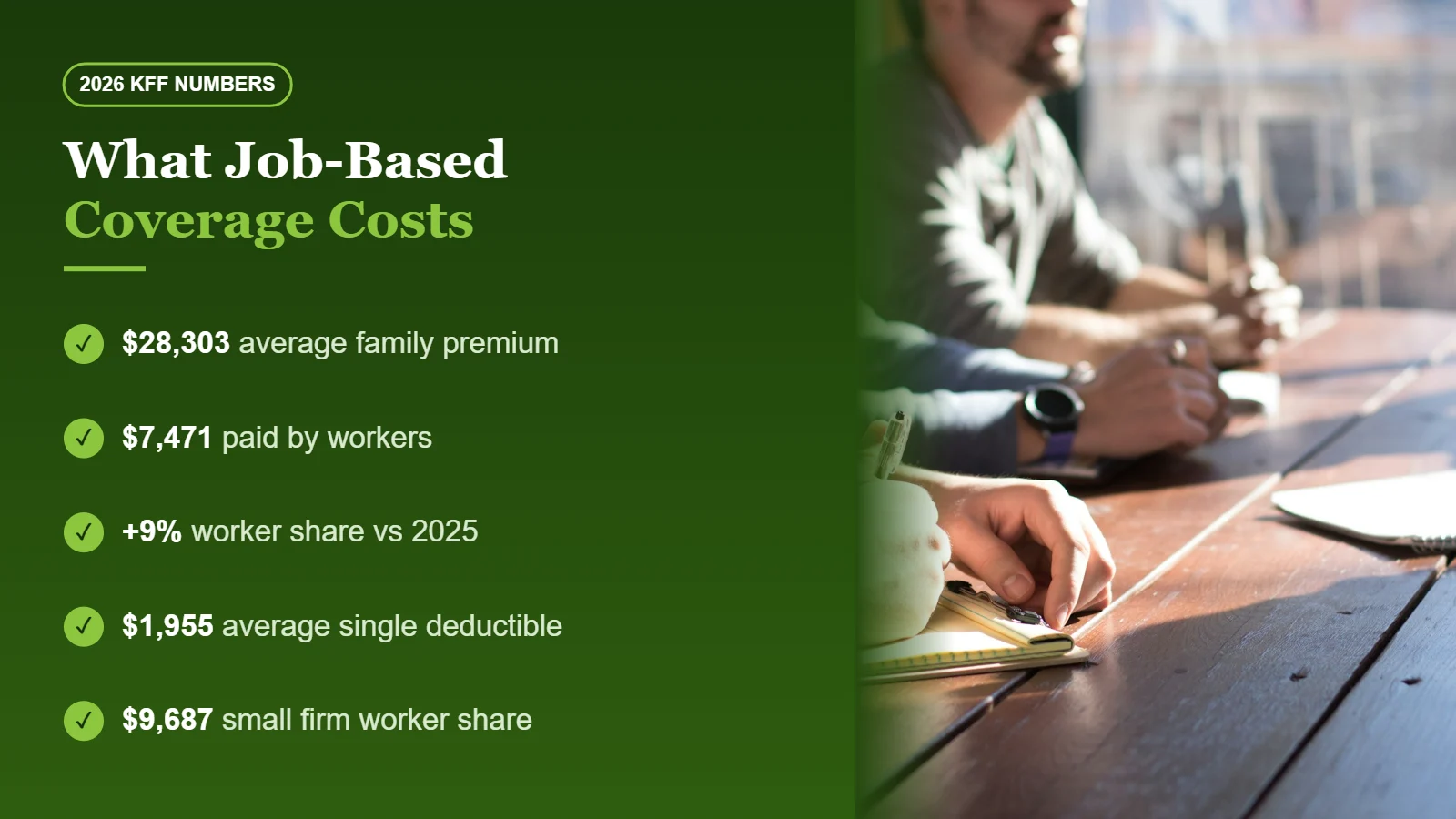
- KFF’s 2026 Employer Health Benefits Survey puts the average family premium at $28,303 a year
- Workers now pay $7,471 of that on average. That’s up 9% from 2025
- The average deductible for single coverage is about $1,955
- Marsh expects total health benefit costs per employee to rise 8.2% in 2027 and says it would be 11% without the cost cutting employers have planned
That last point matters most. Employers are trying to hold the line. And the main ways they do it land on your side of the table.
Why your share is growing faster than the average
Marsh found that 59% of employers plan cost-cutting changes for 2027. The most common one is plan design. That usually means a higher deductible. A deductible is what you pay for care each year before the plan starts sharing the cost.
About two-thirds of large employers also expect to raise the share of the premium that workers pay. So even if total costs rise 8% your paycheck deduction could rise more than that.
A few employers have also dropped coverage for GLP-1 weight-loss drugs to save money right away. If you take one of these medicines then check your 2027 plan documents carefully. Our guide on whether health insurance covers weight loss drugs explains how these rules usually work.
Honestly the part that surprised me most was the gap between small and large companies.
Small company workers often pay more
KFF found that workers at firms with fewer than 200 employees pay about $9,687 a year toward family coverage. That’s $2,847 more than workers at bigger firms. Their average single deductible is also higher at about $2,624 compared with $1,772 at larger companies.
So if you work for a small business the numbers in your enrollment packet may look worse than what your friend at a big company sees. That doesn’t mean your employer is cheap. Smaller groups simply have less buying power.
The plan types you’ll probably see
Most employers offer two to four choices. The names vary but they usually fall into these groups.
| Plan type | Paycheck cost | Deductible | Who it often fits |
|---|---|---|---|
| PPO | Highest | Lower | People who see specialists often and want freedom to choose doctors |
| HMO or EPO | Middle | Low to middle | People happy with one network and a primary doctor |
| High deductible plan with HSA | Lowest | Highest | Healthy people who rarely use care and can save the difference |
| Variable copay plan | Varies | Often none | People willing to use the providers the plan points them to |
That last row is newer. Marsh says 12% of large employers plan to offer variable copay plans in 2027. These usually have no deductible but your copay changes based on which doctor or hospital you pick.
The HSA numbers for 2027
If your employer offers a high deductible plan then a Health Savings Account can soften the blow. An HSA lets you save money for medical bills before taxes. The money is yours and it rolls over every year.
The IRS set these 2027 limits:
| 2027 limit | Self-only | Family |
|---|---|---|
| Maximum HSA contribution | $4,500 | $9,000 |
| Minimum plan deductible to qualify | $1,750 | $3,500 |
| Maximum out-of-pocket | $8,700 | $17,400 |
People 55 or older can add an extra $1,000. And if your employer puts money into your HSA then that counts toward the limit too.
How to pick the right plan in 7 steps
This is the part that actually saves money. It takes about 30 minutes.
Step 1: Look back at last year. Pull up your claims or your pharmacy history. Count doctor visits and prescriptions and any big bills.
Step 2: Add up the yearly premium for each plan. Multiply the paycheck deduction by the number of paychecks. Biweekly pay means 26 paychecks.
Step 3: Add the deductible. Then think about how much of it you’d likely use.
Step 4: Check the out-of-pocket maximum. That’s the most you’d pay in a bad year. Ask yourself if you could handle that number.
Step 5: Search the provider directory for every doctor you care about. Don’t trust last year’s list.
Step 6: Look up each regular prescription in the drug list. A drug can move to a higher price tier without much warning.
Step 7: Compare total cost and not just the paycheck number. Premium plus expected care plus the risk of a bad year.
A hypothetical example
Picture a single worker with no ongoing health conditions. She sees a doctor twice a year and fills one cheap prescription.
Her choices look like this. A PPO costs more per paycheck but has a low deductible. A high deductible plan costs much less per paycheck and her employer adds money to an HSA.
For her the high deductible plan probably wins. She pays less all year and builds tax-free savings. Her real risk is a surprise surgery. Because of that she’d want enough savings to cover the out-of-pocket maximum.
Now picture a family with a child who has asthma and a parent who sees a specialist monthly. The math often flips. The PPO’s higher paycheck cost can be cheaper than paying a big deductible early every single year.

Common mistakes during open enrollment
- Letting it auto-renew. Your plan may have changed even if you didn’t touch it
- Picking by paycheck cost alone. The cheapest deduction can be the most expensive plan if you use care
- Forgetting to check doctors. Networks change every year
- Ignoring the spouse’s plan. Sometimes it’s cheaper to put kids on one plan and adults on another. Some employers charge a spousal surcharge so read the fine print
- Skipping the HSA money. If your employer offers free HSA dollars and you don’t enroll then you leave cash on the table
- Missing the deadline. Open enrollment windows are often only two or three weeks long
What if you miss the window
If you miss open enrollment you’re usually stuck with your current choice until next year. The exception is a qualifying life event. Getting married or having a baby or losing other coverage can open a special enrollment period. These windows are short so act fast. In many plans you have about 30 days.
If you’re leaving a job our guide to COBRA health insurance explains how to keep your coverage for a while. And if job-based coverage gets too expensive you can compare it with ACA open enrollment 2027 options. Just know that employer plans that meet affordability rules can limit your access to marketplace subsidies.
Frequently asked questions
Why is my employer health insurance going up in 2027
Treatment for serious illness costs more and some drugs like GLP-1s are expensive. Employers are reacting by raising deductibles or the worker share of premiums.
Is a high deductible plan a bad idea
Not for everyone. It’s often a good fit for healthy people who can save the difference in an HSA. It’s riskier if you can’t cover the deductible in an emergency.
Can I change my plan in the middle of the year
Usually only after a qualifying life event such as marriage or a new baby or losing other coverage.
Should I drop my employer plan for a marketplace plan
Sometimes it makes sense but often it doesn’t. If your employer offers affordable coverage you may not qualify for marketplace subsidies. Compare both before you decide.
Have a child heading off to school? Compare the family plan and the school plan in our article on health insurance for college students.
Final thoughts
Open enrollment feels like paperwork. But it’s really one of the few times each year you get to control what healthcare costs you. Half an hour with a calculator beats a full year of regret.
And if something in your packet doesn’t make sense then ask HR. That’s literally their job during enrollment season. For more help comparing coverage types read our guide to the best health insurance in the USA.
Disclaimer: This article is general information and not advice for your exact situation. Plans and costs vary by employer and state. Check your plan documents or talk with HR or a licensed agent before you choose.