

Best Health Insurance in the USA for 2026: How to Pick a Plan That Fits

You sit down to pick a health plan and the screen fills with choices. Bronze. Silver. Gold. HMO. PPO. Deductibles that look like car prices. Every plan claims to be a great value. And all you really want to know is simple. Which one won’t leave me with a scary bill if something goes wrong?
That feeling is completely normal. The best health insurance in the USA isn’t the same for everyone. It’s the plan that covers your doctors and your medicines at a total yearly cost you can handle. This guide gives you a clear way to find it in 2026.
The quick answer
To find the best health insurance for you, start with where you’ll get coverage. That’s usually a job or the Marketplace or Medicare or Medicaid. Then compare plans by total yearly cost and not just the monthly premium. Make sure your doctors and prescriptions are covered. And check the out-of-pocket maximum. That’s the most you’d pay in a bad year for covered in-network care.
Where Americans get health insurance
- Employer plans through your job or a spouse’s job
- Marketplace plans at HealthCare.gov or a state marketplace
- Medicare for people 65 and older and some people with disabilities
- Medicaid and CHIP for people and children with lower incomes
- COBRA for a limited time after leaving a job
If you have a job offer with health benefits, that’s often the strongest option because employers usually pay part of the premium. If not, the Marketplace is the main place to shop.
What changed for 2026
The extra pandemic-era premium tax credits ended after 2025. For 2026, help with Marketplace premiums is generally limited to people with income up to 400% of the federal poverty level. Many people saw their costs rise this year. If your income is under that line you may still qualify for meaningful help.
Also new in 2026, bronze and catastrophic Marketplace plans can be paired with a health savings account. That gives healthier people a tax-friendly way to save for medical costs.
And the yearly out-of-pocket maximum for Marketplace plans in 2026 is $10,600 for one person and $21,200 for a family.
Words you’ll see on every plan
Insurance language can make a simple decision feel hard. Here are the terms that matter most, explained in one line each.
- Premium is what you pay every month to keep the plan
- Deductible is what you pay for care before the plan starts sharing costs
- Copay is a flat fee for a visit or a prescription
- Coinsurance is your percentage of a bill after the deductible
- Out-of-pocket maximum is the most you pay in a year for covered in-network care
- Network is the group of doctors and hospitals the plan works with
Once these words click, plan comparison gets much faster. You can look at any plan summary and quickly see what a normal year and a bad year would cost.
Every plan must also give you a Summary of Benefits and Coverage. It’s a standard short document that makes plans easier to compare side by side. Ask for it or download it before you choose.
Plan types in plain words
| Plan type | How it works | Good fit for |
|---|---|---|
| HMO | You use a set network and usually need referrals for specialists | People who want lower costs and don’t mind a smaller network |
| PPO | You can see doctors outside the network for a higher cost | People who want flexibility or see many specialists |
| EPO | No referrals needed but no out-of-network coverage except emergencies | People happy with one network who dislike referrals |
| HDHP with HSA | Higher deductible paired with a tax-advantaged savings account | Healthier people who can save for costs |

Metal tiers made simple
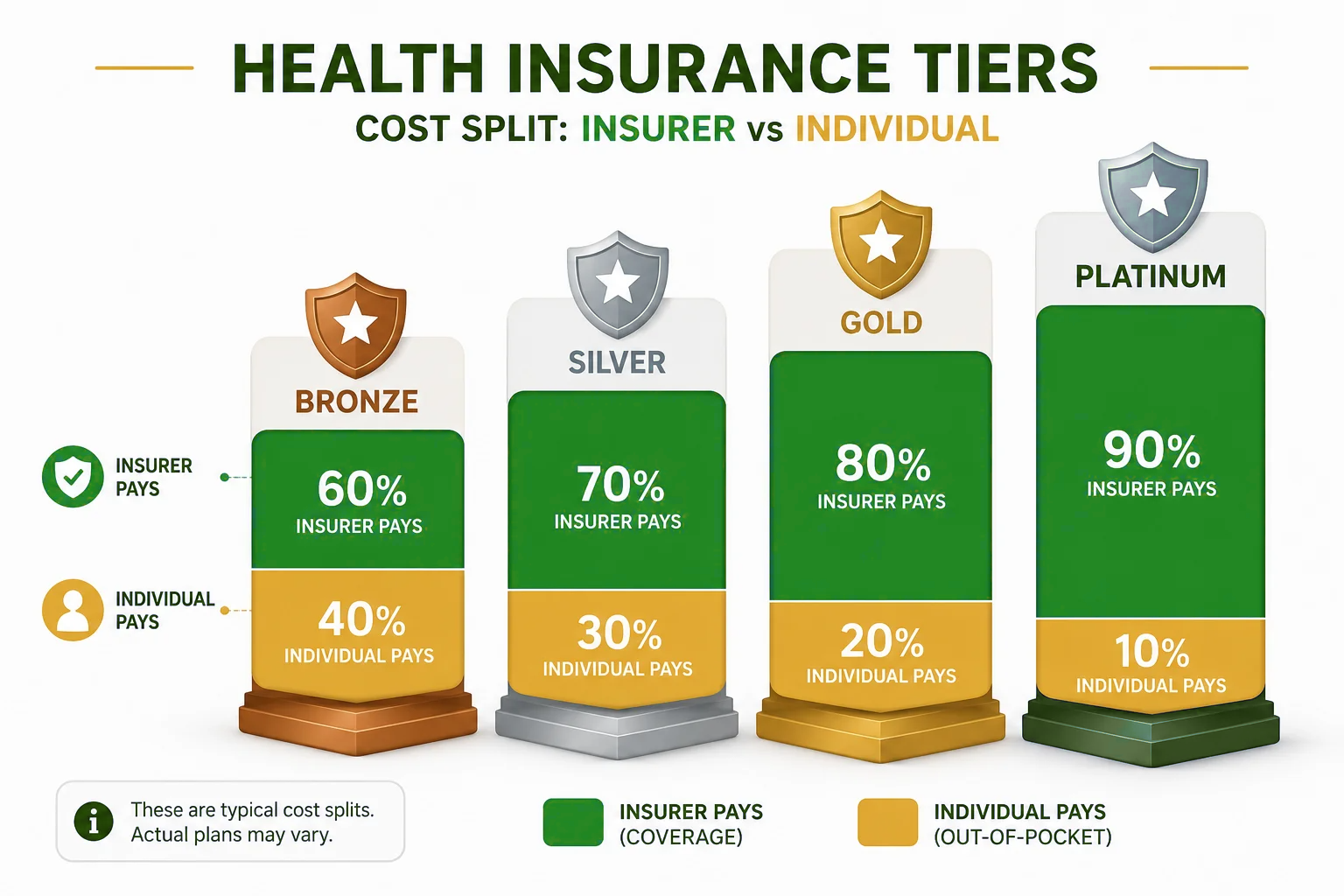
Marketplace plans come in bronze and silver and gold and platinum. The difference is how you and the plan split costs.
Bronze has the lowest premiums and the highest costs when you get care. Good if you rarely see a doctor.
Silver sits in the middle. If your income is low enough, silver plans may come with extra savings that lower your deductible and copays.
Gold and platinum have higher premiums but lower costs when you get care. Good if you have ongoing health needs.
How to compare plans step by step
Step 1: Write down your doctors and hospitals and every prescription.
Step 2: Go to HealthCare.gov or your state marketplace or your employer’s benefits site.
Step 3: Filter plans that include your doctors. Check the drug list for each medicine.
Step 4: Estimate your yearly cost. Add twelve months of premiums plus the deductible and likely copays.
Step 5: Look at the out-of-pocket maximum. Ask yourself whether you could handle that number in a bad year.
Step 6: Check the insurer’s reputation. Your state insurance department and the NAIC Consumer Insurance Search show complaint records.
Step 7: Enroll before the deadline and save your confirmation.
Key dates for 2027 coverage
Open enrollment for 2027 Marketplace plans begins November 1, 2026 in most states. Deadlines vary. Some states run later than others. Check HealthCare.gov or your state marketplace for your exact dates.
Outside open enrollment you can usually enroll only after a qualifying life event. Examples include losing other coverage or moving or getting married or having a baby.
Insurers that often show up in comparisons
Large national companies such as UnitedHealthcare and Aetna and Cigna and Elevance’s Anthem plans appear in many states. Regional Blue Cross Blue Shield companies and Kaiser Permanente are major players in many areas. Newer companies like Oscar and Ambetter sell Marketplace plans in many states too.
Which one is best depends completely on your area and your doctors. A company that’s great in one state may have a narrow network in another. This isn’t an endorsement of any insurer.
A hypothetical example
Picture a healthy 28-year-old who sees a doctor once a year. A bronze HSA-eligible plan with low premiums might fit her well. She puts money into her HSA each month just in case.
Now picture a family with a child who has type 1 diabetes. Regular visits and supplies add up fast. A gold plan with a lower deductible may cost them less over the year even with higher premiums.
These are only illustrations. But they show why the cheapest premium isn’t always the best deal.
One more honest tip. If you’re torn between two plans, look at what happens in a rough year. Picture a surgery or a hospital stay. The plan that still feels manageable in that moment is usually the one you’ll be glad you picked.
Common mistakes when choosing the best health insurance
- Choosing by monthly premium alone
- Not checking that your doctors are in network
- Skipping the drug list check
- Ignoring the out-of-pocket maximum
- Guessing your income too low on a Marketplace application
- Missing open enrollment and waiting a full year
Frequently asked questions
What is the best health insurance company in the USA?
There isn’t one best company for everyone. The best choice depends on your state and doctors and budget. Compare plans in your ZIP code.
Is a PPO better than an HMO?
A PPO gives more freedom but usually costs more. An HMO costs less but limits you to a network. Choose based on how you use care.
Can I get help paying for health insurance in 2026?
Possibly. Many people with income up to 400% of the federal poverty level qualify for premium tax credits. Lower-income people may qualify for Medicaid.
A calm way to finish
Health insurance can feel overwhelming. But it gets easier when you focus on three things. Your doctors. Your medicines. And your worst-case yearly cost. Compare a few plans with those in mind and you’ll make a choice you can feel good about.
If you’re self-employed read our guide on health insurance for self-employed people. Turning 65 soon? See Medicare Advantage vs Original Medicare. And if you just left a job our article on COBRA health insurance explains your options.
Disclaimer: This article is general information and not medical or insurance advice. Plans and prices and rules vary by state and change each year. Check current details with HealthCare.gov or a licensed professional before you enroll.