

6 Easy Ways to Lower Rising Pet Insurance Premiums

The renewal email from your pet insurance company arrives on a quiet Sunday. Your dog is asleep on the couch and hasn’t been sick all year. You open the email expecting the usual price. Instead the monthly cost jumped again.
You didn’t file a big claim. Nothing changed. So why does it keep going up?
If you’ve felt this you’re in good company. Pet owners across the country are seeing higher renewal prices and some of the jumps have been huge. This guide explains why pet insurance premiums are rising and what you can realistically do about it without leaving your pet unprotected.
The quick answer
Pet insurance premiums are rising mainly because vet care keeps getting more expensive and pets cost more to insure as they age. Insurify reports the average dog accident and illness premium rose about 22% from $613 in 2020 to $749 in 2024. Changing your deductible or reimbursement level is often safer than switching companies.
The numbers behind the price jumps
Here’s what the data shows about how fast prices have moved.
| Pet | 2020 average | 2024 average | Change |
|---|---|---|---|
| Dog | $613 | $749 | about 22% |
| Cat | $367 | $386 | about 5% |
These are yearly averages for accident and illness plans reported by Insurify. Notice that about half of the dog increase happened in 2024 alone. That’s when the average went from $675 to $749.
And some individual stories are far more extreme. Insurify noted social media posts where owners said their yearly price jumped from about $200 to more than $1,300. Those are not typical. But they show how wide the swings can be.
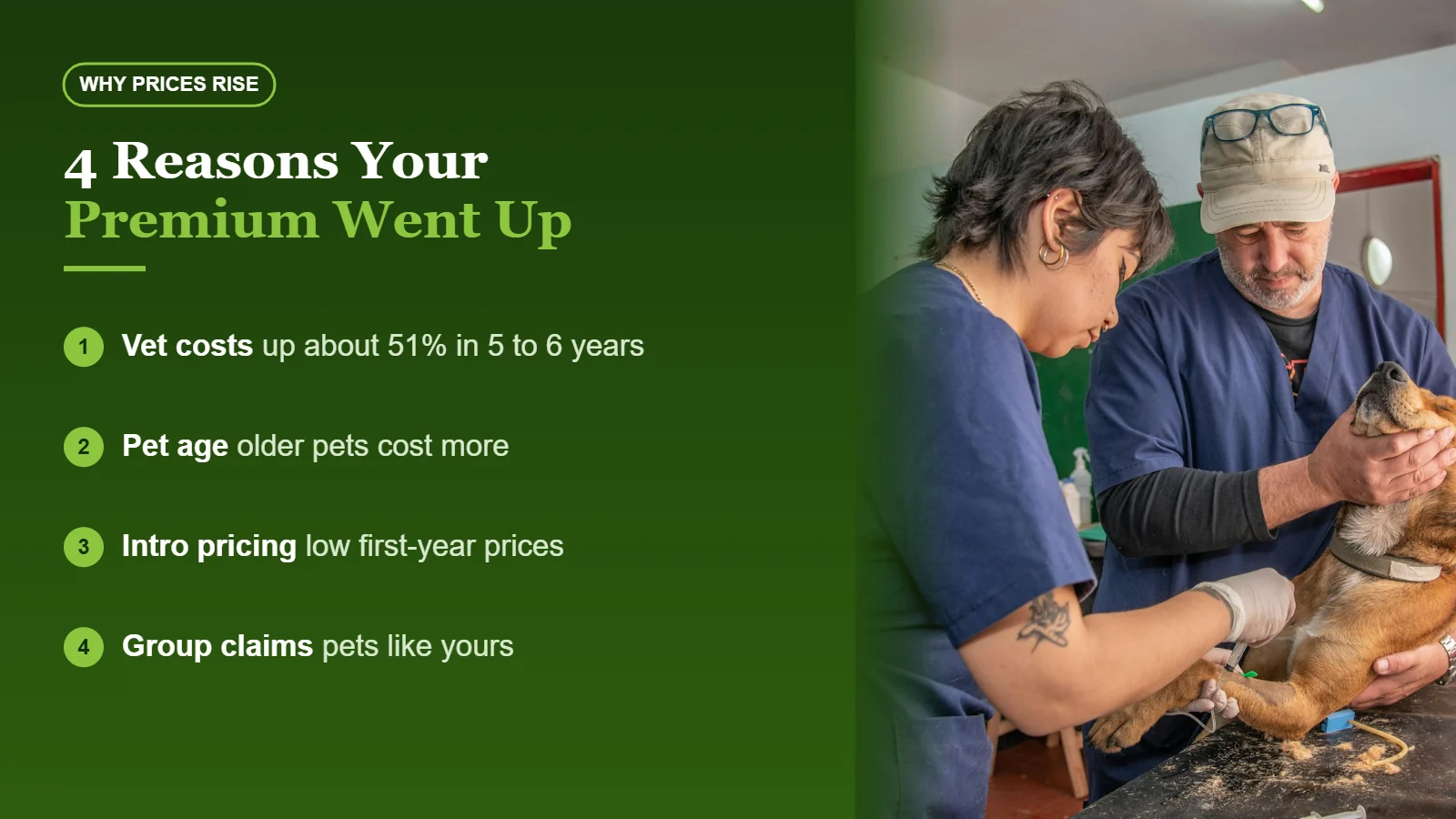
Reason 1: Vet care costs more every year
This is the biggest driver. The Bureau of Labor Statistics shows vet service prices rising about 4.7% to 5.6% a year recently. Over five to six years that adds up to roughly 51%.
Pet insurance is basically a shared pool of money that pays vet bills. When the bills get bigger the pool needs more money. Your premium is your share of that pool.
Better medicine also plays a part. Pets now get MRIs and specialist surgeries and cancer treatment that weren’t common years ago. That’s wonderful for pets. It also costs more.
Reason 2: Your pet is getting older
Many insurers raise prices as pets age. It’s not personal. Older pets simply get sick more often.
Insurify’s data suggests a 10-year-old dog may cost about three times as much to insure as a 1-year-old dog. So even if nothing else changed your renewal would likely climb each birthday.
Some companies handle age differently. Trupanion for example bases price on age at enrollment instead of raising it every year for age. That’s worth asking about when you compare plans.
Our guide on pet insurance for senior pets explains what to expect as your pet gets older.
Reason 3: Low first-year prices
Here’s one people rarely notice. Some insurers set a low introductory price to attract new customers. Then prices rise faster in later years.
It feels like a bait and switch. But it’s more about how the company spreads costs over time. Either way it means the first-year price isn’t a good guide to what you’ll pay in year three.
Reason 4: More people are buying it
Pet insurance is growing fast. NAPHIA reports about 6.98 million US pets were insured at the end of 2025. That’s up 9% in a year. Total premiums grew almost 20% to about $5.68 billion.
More customers can mean more claims data and more pricing changes. And insurers adjust rates for whole groups of pets based on breed and age and location. So your price can rise because of claims made by pets like yours even if your own pet stayed healthy.
Why switching companies is risky
When the price jumps the first instinct is to shop around. Sometimes that’s smart. But there’s a big catch.
Most insurers won’t cover pre-existing conditions. That means any illness your pet already had before the new policy starts. If your dog has allergies or a bad knee or a heart murmur the new company will likely exclude it.
So a cheaper new policy could leave your pet’s most likely future claims uncovered. That’s why many owners end up stuck paying higher renewals. The waiting periods on new policies are another issue. Our article on pet insurance waiting periods explains those.
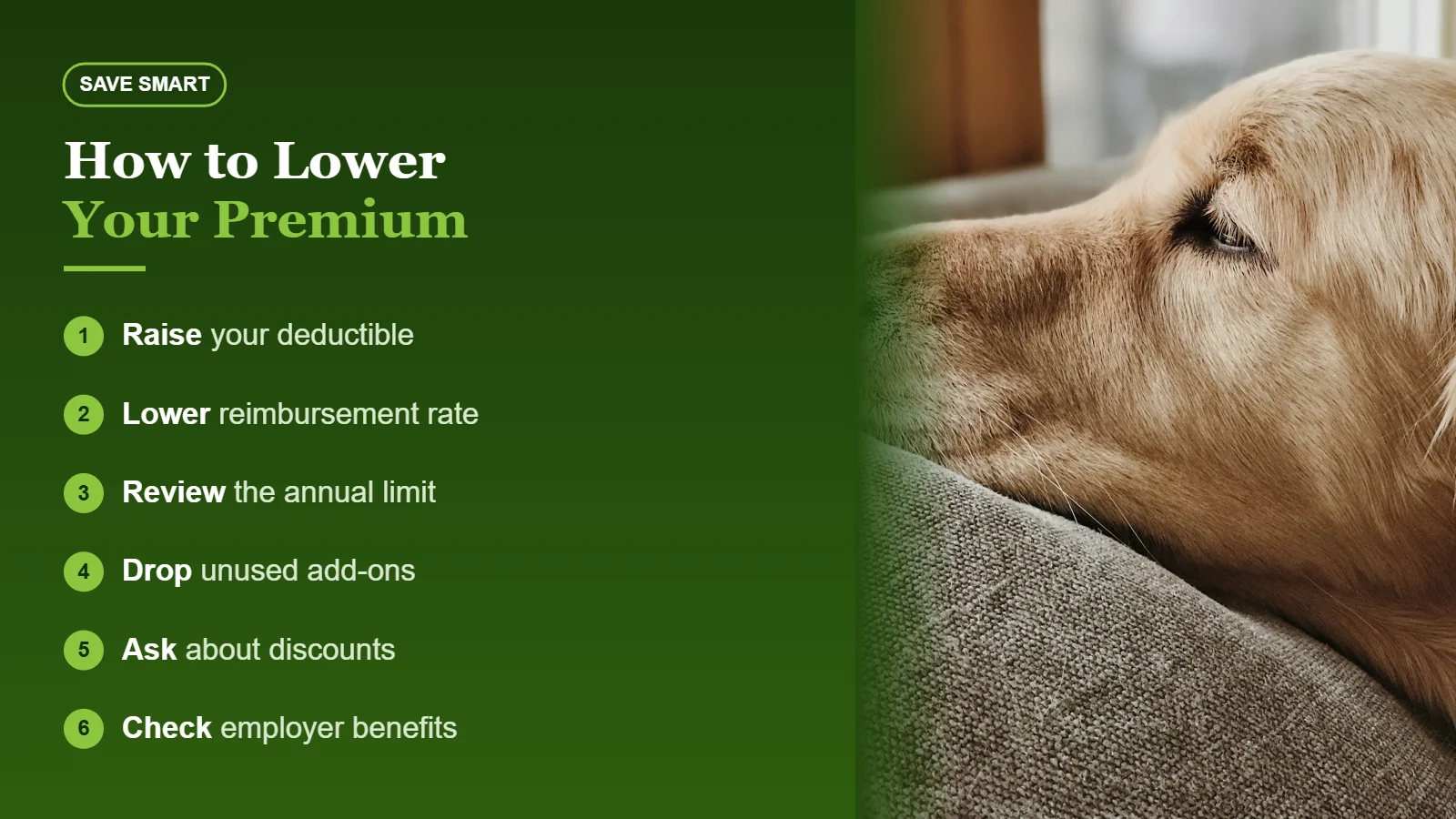
6 easy ways to lower your pet insurance premiums
You don’t have to just accept the increase. Try these before you cancel or switch.
Way 1: Raise your deductible. Moving from $250 to $500 or $750 can lower your monthly price noticeably.
Way 2: Lower your reimbursement rate. Going from 90% to 80% or 70% means you pay a bit more when you claim but less every month.
Way 3: Review the annual limit. An unlimited plan costs more. A high but capped limit may be enough for many pets.
Way 4: Drop add-ons you don’t use. A wellness add-on for routine care can cost more than the care itself.
Way 5: Ask about discounts. Many insurers give discounts for multiple pets or paying yearly. Our guide on multi-pet insurance discounts covers this.
Way 6: Check your employer benefits. Some companies offer pet insurance at a group rate. See our article on employer pet insurance.
A hypothetical example
Picture a 7-year-old Labrador with no health problems so far. The owner pays about $70 a month. At renewal the new price is $92.
Option A is switching. A new company quotes $65. But the dog had an ear infection last year so ear problems would be excluded. And a new waiting period applies.
Option B is adjusting the current plan. Raising the deductible from $250 to $750 and lowering reimbursement from 90% to 80% might bring the price back near $70.
For a healthy dog Option B often wins. The dog keeps full coverage for any history. The owner just pays a bit more if something happens.
Questions to ask your insurer before you renew
A short phone call can tell you a lot. Ask these questions and write down the answers.
- Why exactly did my price go up this year
- Will my price keep rising every year because of my pet’s age
- What would my price be with a higher deductible or lower reimbursement
- Are there any discounts I’m not using right now
- Did any coverage terms change along with the price
Honestly the first question alone can be eye-opening. Sometimes the answer is local vet costs. Sometimes it’s age. Knowing the reason helps you decide whether the increase is likely to keep happening.
When it might make sense to cancel
Sometimes dropping pet insurance is a fair choice. For example if you have a solid emergency fund of several thousand dollars set aside only for vet bills. Or if your pet is very old and most likely problems are already excluded.
If you cancel please start a dedicated vet savings account the same month. Put in at least what you were paying for insurance. Emergencies don’t wait for your savings to catch up.
Common mistakes
- Switching without checking exclusions. A cheaper plan can exclude your pet’s existing conditions
- Canceling with no backup plan. One surgery can cost thousands
- Ignoring the deductible lever. It’s often the easiest way to save
- Judging by the first-year price. Ask how prices usually change as pets age
- Forgetting to read the renewal letter. Coverage terms can change along with price
Frequently asked questions
Why did my pet insurance go up if I didn’t make a claim
Your price is based on costs for many pets like yours and on your pet’s age. Rising vet prices affect everyone even pets who stayed healthy.
Is pet insurance still worth it in 2026
For many owners yes. Especially if a surprise bill of a few thousand dollars would be hard to pay. It depends on your budget and your pet’s health.
Do pet insurance prices go up every year
Often but not always. It depends on the insurer and your pet’s age and local vet costs.
Are cats cheaper to insure than dogs
Usually yes. Cat premiums have also risen more slowly than dog premiums in recent years.
Final thoughts
Rising premiums are frustrating. Especially when your pet is perfectly healthy. But the cause is mostly real. Vet care costs more and pets age.
The good news is you have levers to pull. Adjust the plan before you abandon it. And if you do switch then read the exclusions twice. Your pet’s history matters more than the monthly price. For a fuller comparison see our guide to the best pet insurance policy in the USA.
Disclaimer: This article is general information and not veterinary or insurance advice. Prices and coverage vary by insurer and state and pet. Read your policy and talk with your vet or a licensed agent before you make changes.