

ACA Open Enrollment 2027: How to Pay Less

The email usually shows up in late October. The subject line says something about your 2027 plan and you almost delete it. Then you open it and the new monthly price is a lot higher than this year. Or worse. It says your plan won’t be offered next year at all.
If that sounds familiar you’re not alone. ACA open enrollment 2027 starts November 1 and this year has more moving parts than usual. Prices are up again. Some insurers are leaving. And a few rules that used to protect your wallet are gone. This guide walks through what changed and the simple moves that can keep your bill under control.
The quick answer
In most states you can shop for 2027 Marketplace coverage from November 1, 2026 to January 15, 2027. Pick a plan by December 15 if you want coverage to start on January 1. Don’t let your plan renew on autopilot this year. Log in and update your income first. Then compare at least three plans by total yearly cost and not just the monthly premium.
Key dates for ACA open enrollment 2027
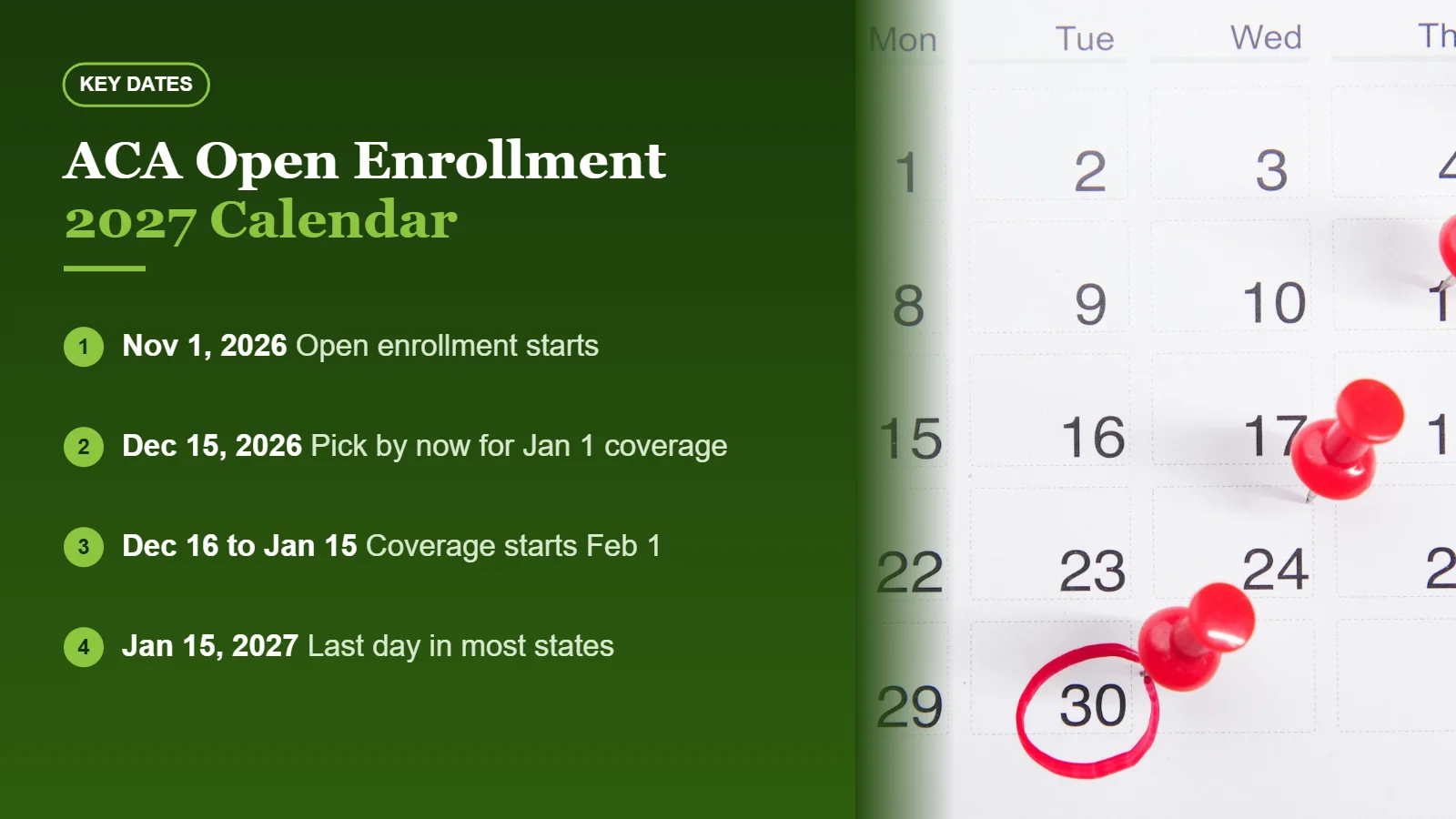
Here’s the calendar for states that use HealthCare.gov. States that run their own exchange can set different dates so check your state site if you’re in one of them.
| Date | What happens |
|---|---|
| November 1, 2026 | Open enrollment starts |
| December 15, 2026 | Last day to pick a plan for coverage starting January 1 |
| December 16 to January 15 | Plans picked in this window start February 1 |
| January 15, 2027 | Open enrollment ends in most states |
Miss January 15 and you’re usually locked out until next fall. The only way in after that is a special enrollment period. That needs a qualifying life event such as losing job-based coverage or moving or having a baby.
Why your premium is going up again
A premium is the amount you pay each month to keep the plan active. For 2027 that number is climbing for a second year in a row.
According to KFF the average benchmark silver premium is rising about 13% for 2027. That comes right after a 26% jump for 2026. States on HealthCare.gov are seeing about 11% on average. States with their own exchange are closer to 16%. Insurers originally asked for a median increase of about 15% and some states like Arizona saw requests near 29%.
Here’s the part people miss. If you get a subsidy your share may not rise nearly that much. Subsidies are tied to the second-lowest-cost silver plan in your area. When that benchmark goes up your tax credit usually goes up with it. The people who feel the full increase are those who earn too much for help or who buy coverage off the Marketplace.
The subsidy cliff is back
The extra federal help that started during the pandemic expired at the end of 2025. That brought back an old rule called the subsidy cliff.
For 2027 coverage the cliff sits at 400% of the federal poverty level. That’s about $63,840 for a single person and about $132,000 for a family of four. Earn even a dollar over that line and federal premium help stops completely. It doesn’t fade out gently. It just ends.
Honestly this is where a lot of middle-income families get surprised. A freelancer with a good year or a couple who both got raises can cross the line without noticing. If you’re anywhere near it then keep reading because there’s a legal way to bring your countable income down.
No more cap on paying back extra help
There’s another change that hits at tax time. Your subsidy is based on the income you expect. If you end up earning more you may have to repay some of it when you file. Starting with tax year 2026 the old limits on that repayment are gone. So a bad income guess can now mean a much bigger tax bill in spring.
Insurers leaving: what happens to your plan
Insurers are pulling out of the Marketplace in more than 20 states for 2027. KFF reports that Cigna is leaving the individual market in all 11 states where it sold plans. Hundreds of thousands of people will see their current plan end on December 31.
If your plan is ending the Marketplace may move you into a replacement plan automatically. That sounds handy. But the system picks for you and it won’t check whether your doctor is in network or whether your medications are covered the same way. That’s the main reason not to rely on auto renewal this year.
Other rule changes worth knowing
- Higher out-of-pocket limit: the most you can pay for covered care in a year rises to $12,000 for one person in 2027 up from $10,600
- Catastrophic plans: these low-premium plans are again limited to people under 30 unless you get a hardship or affordability exemption
- Immigrant eligibility: starting in 2027 only lawful permanent residents and a few other groups qualify for premium tax credits
- Less free help: federal funding for navigators was cut sharply so local enrollment help may be harder to book
- Canceled enrollments: the government canceled hundreds of thousands of enrollments it flagged as suspicious so log in and confirm your own account looks right
How to pay less in 2027

Step 1: Update your income before you shop. Your subsidy is based on what you expect to earn in 2027. Use your best honest estimate. Include side gigs and expected raises. A good number now saves you a nasty surprise at tax time.
Step 2: Use an HSA if you’re near the cliff. All Marketplace bronze and catastrophic plans are HSA eligible. Money you put into a health savings account lowers the income used for subsidy rules. For 2027 the limit is $4,500 for self-only coverage and $9,000 for family coverage. For someone just over the cliff that can be the difference between full price and real help.
Step 3: Look hard at silver if your income is lower. If you earn under 250% of the poverty level a silver plan can come with cost-sharing reductions. Those lower your deductible and copays. A bronze plan may look cheaper per month and still cost you more over the year.
Step 4: Compare total yearly cost. Add twelve months of premiums to the deductible and think about how much care you really use. The average Marketplace deductible was about $3,786 in 2026 so this math matters.
Step 5: Check your doctors and prescriptions. Networks and drug lists change every year. Search your doctor’s name and each medication inside the plan details before you click enroll.
Step 6: Look for state help. Some states now pay part of the gap themselves. New Mexico and California and New Jersey have programs. Virginia and Rhode Island are adding new ones for 2027. Your state exchange will show this help automatically when you apply.
Real situations and what usually fits
A self-employed designer near the cliff. Picture someone whose income bounces around $60,000 to $70,000. A bronze plan paired with an HSA can lower their countable income and keep subsidies alive. Our guide to health insurance for self-employed people goes deeper on budgeting for this.
Someone who just lost a job. You can compare COBRA with a Marketplace plan. Losing job-based coverage also opens a special enrollment window outside the normal dates. Read our breakdown of COBRA health insurance before you choose.
A college student. A parent’s plan or a school plan may beat the Marketplace. Here’s our guide on health insurance for college students.
Someone turning 65 soon. Medicare has its own enrollment rules. Our comparison of Medicare Advantage vs Original Medicare is a better starting point.
Common mistakes during open enrollment
- Letting the plan renew without opening the account
- Using last year’s income when this year looks different
- Picking the lowest premium and ignoring a huge deductible
- Skipping the doctor and drug check
- Trusting a cold call that promises a free plan
- Waiting until January 15 and running into a busy website
That cold call one is worth a second look. Real Marketplace help never asks you to pay to enroll. If someone pushes hard on the phone then hang up and go straight to HealthCare.gov or your state exchange.
Frequently asked questions
When does ACA open enrollment 2027 end
In most states it ends January 15, 2027. Choose a plan by December 15 if you want coverage on January 1. Some state exchanges set their own dates.
Will my plan renew automatically
Often yes. But if your insurer is leaving you may be moved to a different plan. It’s safer to log in and choose your own.
What income is too high for a subsidy in 2027
About $63,840 for one person and about $132,000 for a family of four. Above that federal help stops unless your state adds its own.
Can I lower my income for subsidy purposes
Contributions to an HSA or a traditional IRA can lower the income used for subsidy rules. An HSA needs an HSA-eligible plan such as a Marketplace bronze plan.
Final thoughts
This year rewards people who spend one quiet evening on their account. Update the income. Check the doctors. Compare the full yearly cost. That hour can easily be worth more than any other money task you do this month.
If you want a wider view of plan types our best health insurance in USA guide explains how to compare them.
Disclaimer: This article is general information and not advice for your exact situation. Dates and prices and rules can differ by state and can change. Confirm details on HealthCare.gov or your state exchange or with a licensed agent before you enroll.