
General Liability vs Professional Liability Insurance

The Claim That Taught Me the Difference the Hard Way
A client once told me my advice cost her business real money, a missed detail in a report I’d delivered led to a decision that backfired for her. I panicked and pulled up my insurance policy, certain I was covered, only to find out my general liability policy covered almost none of it. It was built for slip-and-fall accidents and property damage, not for a claim about the quality of my actual work.
That gap is exactly where general liability vs professional liability insurance stops being a technical distinction and becomes a genuinely expensive lesson. I got lucky, the claim was resolved without a lawsuit, but it sent me straight into fixing a coverage gap I hadn’t even known existed. Here’s everything I learned working through it, the actual differences, the real 2026 costs, and where business owners consistently get this wrong.
I’ve already covered general small business coverage in my best business insurance guide and the freelancer-specific angle in my business insurance for freelancers guide here on Insurance Pikr. This one goes deeper specifically into general liability vs professional liability insurance, since it’s one of the most common points of confusion for small business owners across the country.
The Core Difference in General Liability vs Professional Liability Insurance
The distinction comes down to what type of harm is being claimed.
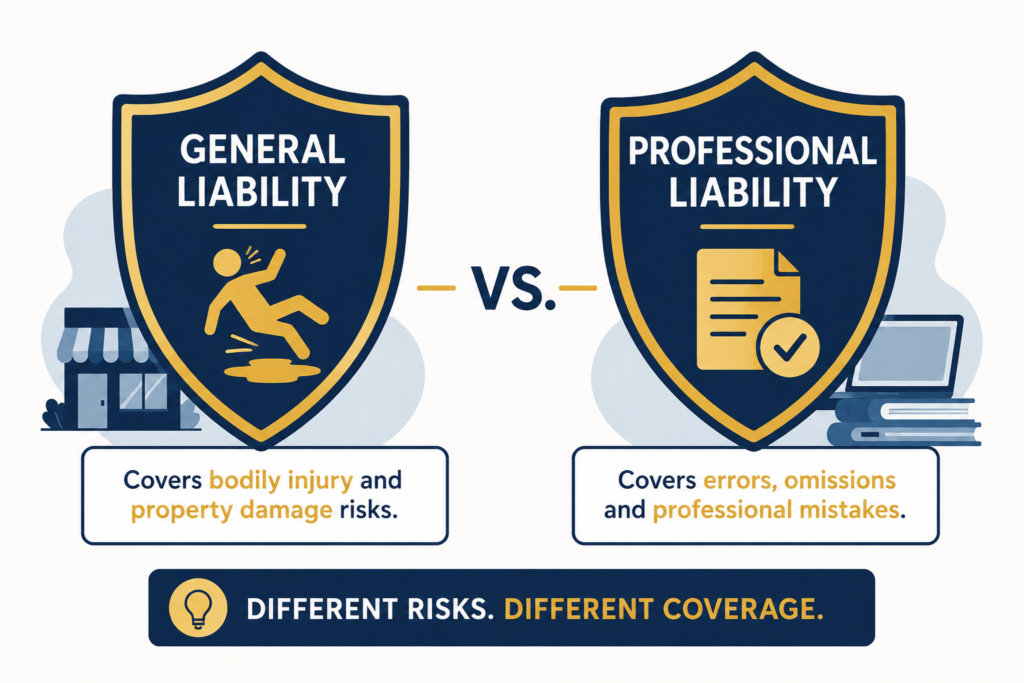
General liability insurance covers physical risks: bodily injury, property damage, and personal or advertising injury connected to your business operations. A customer slipping on a wet floor in your store, an employee accidentally damaging a client’s property while working off-site, these are textbook general liability claims. It’s the coverage most commercial landlords, clients, and government contracts require before you’re even allowed to sign a lease or start a project.
Professional liability insurance, also called errors and omissions (E&O) insurance, covers claims about the quality or outcome of your actual professional work: a missed deadline that cost a client money, a design flaw, bad financial advice, an error in a report or contract. This is the coverage that would have applied to my situation, and it’s specifically what general liability does not cover, no matter how the claim is framed.
Who Actually Needs Each Type
Most businesses with a physical presence, employees, or in-person customer interaction need general liability insurance, regardless of industry. Retail shops, restaurants, contractors, and anyone with foot traffic or off-site work fall squarely into this category.
Professional liability insurance is specifically for businesses providing advice, expertise, or a paid service where the outcome itself could be disputed: consultants, accountants, lawyers, designers, marketers, developers, architects, and similar service-based professionals. If your business does both, sees customers in person and also provides paid professional advice, carrying both policies is genuinely the standard, not the exception.
What General Liability vs Professional Liability Insurance Actually Costs
Real 2026 data across multiple industry sources shows a consistent pattern, professional liability costs meaningfully more than general liability for most solo and small businesses:
| Coverage Type | Sole Proprietor / Solo (Monthly) | Small Business, 1-4 Employees (Monthly) | Annual (1-4 Employees) |
|---|---|---|---|
| General liability | ~$28 | $40-$123 | $500-$1,474 |
| Professional liability (E&O) | ~$80 | $30-$70 (avg. $56) | $675 |
| Business Owner’s Policy (bundled) | N/A | $57-$150 | $684-$1,800 |
(National averages assume $1 million per-occurrence/$1-2 million aggregate limits. Your actual quote depends heavily on industry, location, claims history, and employee count, businesses in higher-risk industries or high-foot-traffic locations land well above these averages.)
Small businesses with one to four employees pay roughly $123 a month on average for general liability with standard $1 million/$2 million limits, based on analysis across 408 industries and all 50 states. Professional liability, by comparison, averages around $56 a month nationally for similarly sized businesses, though the specific profession matters a lot, higher-liability fields like financial consulting or healthcare-adjacent advice typically sit well above that average.
Why the Cost Gap Exists
The pricing difference isn’t arbitrary. According to claims data compiled by The Hartford, the average general liability claim costs around $45,000 to resolve, while professional liability claims involving reputational harm, like libel or slander disputes, average roughly $35,000, despite being comparatively rare, making up less than 15% of all claims filed.
Professional liability claims also tend to involve longer legal disputes, since proving whether advice or work quality was actually deficient is inherently more subjective than proving a customer slipped on a wet floor, which is part of why insurers price E&O coverage higher relative to the claim frequency.
A Real Example of Where the Coverage Gap Shows Up
Picture a marketing consultant who only carries general liability because a friend recommended it years ago. A client later claims a campaign strategy the consultant delivered directly caused a significant revenue loss. General liability insurance will deny this claim outright, it has nothing to do with bodily injury or property damage, it’s entirely about the quality and outcome of professional work. Without a separate professional liability policy in place, that consultant is now personally exposed to legal fees and a potential settlement with no coverage backing them at all.
This exact gap is one of the most common issues seen among professional service businesses that assume general liability is a complete safety net. It isn’t, and it was never designed to be.
Common Mistakes Business Owners Make With General Liability vs Professional Liability Insurance
- Assuming general liability covers everything: It’s a genuinely essential policy, but it was built specifically for physical risks, not disputes about your actual work product or advice.
- Skipping professional liability because “nothing has gone wrong yet:” The businesses that need this coverage most are often the ones who’ve never had a claim, which is exactly why they assume they don’t need it.
- Not checking client or contract requirements before assuming one policy covers both: Some client contracts specifically require proof of professional liability, general liability alone won’t satisfy that requirement even if you already carry it.
- Underestimating reputational harm claims: Libel and slander-related professional liability claims are rare but expensive, averaging around $35,000 per claim according to industry claims data.
- Forgetting that both policies typically need to work together: Businesses doing physical work and giving professional advice, like a contractor who also consults on designs, genuinely need both types of coverage, not one instead of the other.
- Buying coverage based on price alone rather than actual exposure: A cheaper professional liability policy with a lower aggregate limit may not actually cover a serious claim, match the limit to your realistic worst-case exposure, not just the lowest quote.
Where This Leaves Me Now
I added a professional liability policy within a week of that close call, and it’s genuinely changed how I think about client work, not out of fear, but because I finally understood what my original policy was actually built to do versus what I’d assumed it covered. The gap between general liability vs professional liability insurance isn’t a technicality, it’s the difference between being protected and discovering you weren’t, usually at the worst possible moment.
If you’re running a service-based business and only carry general liability right now, it’s worth the ten minutes it takes to check whether professional liability coverage is a gap you’re currently sitting on. If you’re also working through other coverage decisions, I’ve written about my own experience with life insurance, home insurance, health insurance, car insurance, and pet insurance here on Insurance Pikr too.
For real-time quotes and industry-specific breakdowns, MoneyGeek’s general liability vs professional liability comparison and NerdWallet’s general liability insurance guide are both solid, current places to check numbers specific to your industry before you buy either policy.
I write about this kind of practical, real-world insurance stuff regularly over on Insurance Pikr, so if this helped clear up a gap in your own coverage, there’s more where it came from.