
Health Insurance for Self-Employed

What I Learned the Month I Quit My Job to Freelance Full-Time
The day I quit my job to freelance full-time, I felt genuinely unstoppable, right up until I opened the Healthcare.gov website that same week and saw a premium quote that made me close the laptop and walk away for a few hours. No employer contribution, no HR department quietly handling the paperwork, just me, my actual income, and a number that felt like it belonged to someone with a much bigger business than mine.
That first quote shock is basically a rite of passage for anyone going independent, and it took me longer than I’d like to admit to actually understand the real options, the tax deduction nobody explains clearly, and the moves that brought my real cost down significantly from that first number I saw. This is everything I wish someone had walked me through before that week.
I’ve already covered general health insurance strategy in my best health insurance in USA guide and the student-specific angle in my health insurance for college students guide here on Insurance Pikr. This one is specifically about health insurance for self-employed workers, freelancers, 1099 contractors, and small business owners without a team behind them.
Why Health Insurance for Self-Employed Workers Looks So Different in 2026
Around 16 million Americans are currently self-employed, and that number keeps climbing as more people shift into freelance, contract, and gig-based work. Unlike a traditional job, there’s no employer covering part of your premium, so the full sticker price lands entirely on you, which is exactly why that first Healthcare.gov quote can feel so much higher than what a friend with a corporate job might be paying for similar coverage.
There’s also a real policy shift worth knowing about heading into this year: the enhanced ACA subsidies that had been in place for the past few years expired at the end of 2025. That means households earning above 400% of the federal poverty level, roughly $59,100 for an individual, no longer receive Marketplace subsidies at all in 2026, a hard cutoff that didn’t exist the last few years. If your income sits near that line, it’s worth running your exact numbers on Healthcare.gov rather than assuming last year’s subsidy still applies.
The Real Options for Health Insurance for Self-Employed Workers
ACA Marketplace plans remain the most common starting point, and for good reason, roughly 9 out of 10 people who enroll through the Marketplace still receive some form of subsidy, even with the enhanced credits gone. If your income fluctuates month to month, which is normal for freelance work, enrollment is based on your projected annual income, not a single month’s earnings, so irregular income doesn’t disqualify you the way many assume it does.
A spouse’s employer plan, if available, is often the cheapest path of all, since it comes with an employer contribution you can’t access on your own. Worth checking before assuming you need to buy your own coverage entirely.
COBRA continuation coverage lets you temporarily keep your previous employer’s exact plan for up to 18-36 months after leaving a job, but you pay the full premium yourself plus an administrative fee, making it one of the more expensive bridge options rather than a long-term solution.
Health sharing ministries market themselves as a cheaper alternative, but it’s worth being direct about this: these are not insurance, participation is voluntary for the group, and claims can legally be denied with real financial risk to you. Treat these with genuine caution rather than as a true substitute for coverage.
Private carrier plans outside the Marketplace sometimes offer lower deductibles ($3,000-$7,000) compared to Marketplace deductibles, which can run $7,500-$9,000 or higher per person in 2026. These can be worth comparing directly against a subsidized Marketplace plan, though without a subsidy attached, they’re rarely cheaper overall.
Group-of-one or small business group plans almost always end up more expensive than equivalent subsidized Marketplace coverage. Unless you actually have employees, it’s worth quoting ACA Marketplace plans first before considering this route.
What Health Insurance for Self-Employed Workers Actually Costs
Real 2026 numbers, based on current rate data across major markets:
| Plan Type | Typical Monthly Premium | Typical Deductible |
|---|---|---|
| Marketplace Bronze (HDHP) | $280-$450 | $7,500-$9,000+ |
| Marketplace Silver PPO (age 31-45) | ~$789 | $4,000-$6,000 |
| Marketplace Silver EPO (age 31-45) | ~$676 | $4,000-$6,000 |
| Full-price average (all metal tiers) | ~$619 | Varies by tier |
| Private carrier plan | Often 20-40% lower than Marketplace | $3,000-$7,000 |
| Short-term bridge plan | $100-$250 | Excludes pre-existing conditions |
Bronze and Silver plans both qualify as HSA-eligible high-deductible health plans in 2026, an important pairing covered in more detail below.
The Tax Deduction Almost Every Self-Employed Person Misses
This is the part that actually made the numbers feel manageable for me. If you’re self-employed, you can generally deduct 100% of your health, dental, and vision premiums, for yourself, your spouse, and your dependents, directly against your income, even if you don’t itemize deductions.
Here’s a real example of how this plays out: a self-employed worker paying $7,200 a year in HDHP premiums plus a full $4,300 HSA contribution creates an $11,500 total deduction. At a 22% tax bracket, that’s roughly $2,530 in actual tax savings every single year. There’s a compounding effect too, since this deduction lowers your adjusted gross income, it can actually increase your ACA premium tax credit for the following year, meaning the deduction and the subsidy work together rather than separately.
The deduction can’t exceed your net self-employment income for the year, and if you’re already receiving premium tax credits, you can only deduct the portion you actually paid out of pocket, not the subsidized amount. Keep your 1095-A form and premium statements with your tax records either way.
Pairing an HDHP With an HSA (The Move That Changed My Math)
If you enroll in a High Deductible Health Plan, and Bronze or Silver Marketplace plans both qualify in 2026, you become eligible to open a Health Savings Account. For 2026, contribution limits sit at $4,400 for individual coverage and $8,750 for family coverage, with an extra $1,000 catch-up allowed if you’re 55 or older.
HSAs offer a genuine triple tax advantage: contributions are tax-deductible, growth inside the account is tax-free, and withdrawals for qualified medical expenses are also tax-free. Unlike a Flexible Spending Account, HSA funds roll over indefinitely and aren’t tied to an employer, they stay yours even if you stop freelancing later. After age 65, withdrawals for non-medical expenses work similarly to a traditional IRA, which makes an HSA one of the more underrated retirement tools available specifically to self-employed workers.
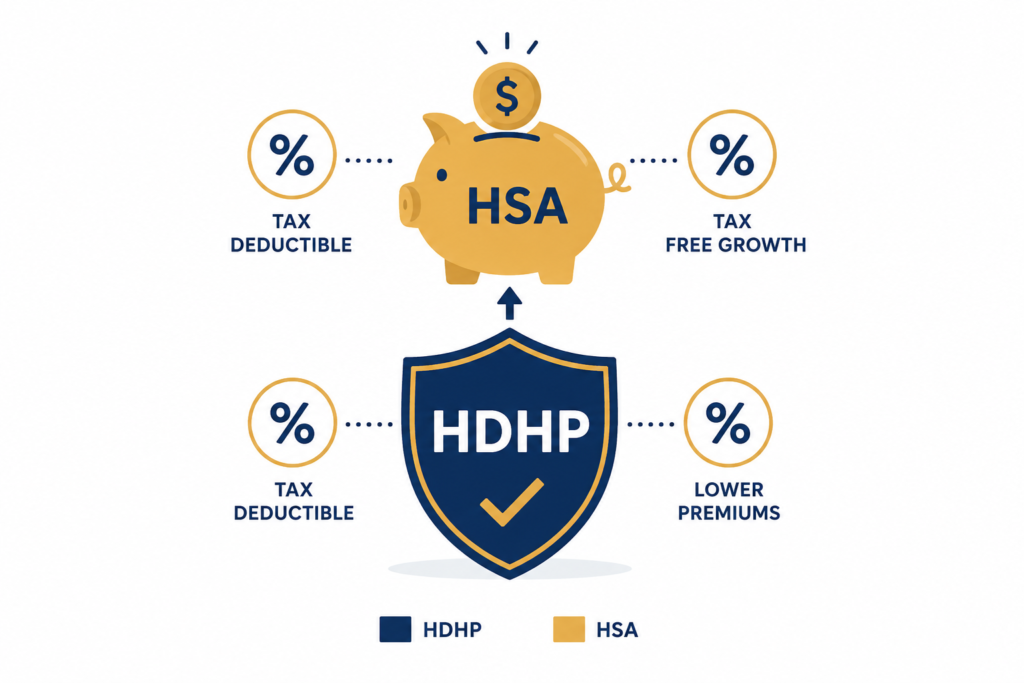
To qualify for HSA contributions, you can’t have other non-HDHP coverage, can’t be enrolled in Medicare, and need a valid Social Security number and U.S. citizenship or permanent residency, worth confirming your specific plan meets IRS requirements before assuming eligibility.
What About Short-Term and Bridge Coverage?
Short-term health insurance plans exist outside the ACA Marketplace entirely and can genuinely help during a temporary gap, between finishing a job and your Marketplace plan starting, for example. They’re inexpensive, typically $100-$250 a month, and fast to activate. The tradeoff is real: they exclude pre-existing conditions entirely, and if you’ve been treated for something like diabetes, hypertension, or arthritis in recent years, a short-term plan won’t cover care related to it. Use these strictly as emergency bridges, not as ongoing coverage.
Common Mistakes I’d Tell Any Self-Employed Person to Avoid
- Assuming irregular income disqualifies you from Marketplace enrollment: Eligibility runs on projected annual income, not last month’s invoice total, freelancers with genuinely inconsistent income still qualify and often still receive subsidies.
- Treating health sharing ministries as equivalent to real insurance: They carry real risk of denied claims with no legal guarantee of payment, understand that tradeoff clearly before relying on one.
- Not pairing an HDHP with an HSA when eligible: This is one of the most effective tax moves available specifically to self-employed workers, and it’s frequently left on the table simply because people don’t realize Bronze and Silver plans qualify.
- Forgetting the self-employed health insurance deduction exists: A meaningful number of freelancers pay full price on their tax return without realizing their premiums are deductible against their income.
- Not checking your income against the 400% FPL subsidy cliff: With enhanced subsidies gone in 2026, crossing that threshold can mean losing your entire subsidy, not just a portion of it.
- Choosing group coverage without quoting ACA first: Group-of-one plans almost always cost more than a subsidized Marketplace plan for solo freelancers without employees.
Where This Leaves Me Now
I ended up on a Silver Marketplace plan paired with an HSA, and between the subsidy I actually qualified for and the tax deduction I almost missed entirely, my real annual cost ended up far lower than that first quote that made me shut my laptop. The sticker shock was real, but so was almost every option I found afterward to bring it back down to something reasonable.
If you’re newly self-employed or have been putting off sorting this out, running your actual numbers on Healthcare.gov takes less time than it feels like it will, and it’s non-negotiable if you want an accurate picture instead of guessing. If you’re also working through other coverage decisions, I’ve written about my own experience with life insurance, home insurance, car insurance, business insurance for freelancers, and pet insurance here on Insurance Pikr too.
For official subsidy calculators and enrollment deadlines, Healthcare.gov remains the essential starting point, and Fidelity’s self-employed health insurance guide is a solid, unbiased resource for working through the HSA and tax-planning side of the decision in more depth.
I write about this kind of practical, real-world insurance stuff regularly over on Insurance Pikr, so if this helped, there’s more where it came from.