
Health Insurance for College Students in 2026: The $1,100 Lesson I Learned About “Staying on My Parent’s Plan”

I assumed I was covered. My parents had good insurance, I was under 26, I figured that was the whole story. Then I got strep throat during my sophomore year, three states away from home, walked into the nearest urgent care, and found out two weeks later that the entire visit was billed as out-of-network. $1,100, for strep throat.
Nobody had told me that staying on a parent’s plan and actually having usable coverage at school are two different things. The plan was real, my name was on it, but the provider network back home didn’t extend to my campus, and I had no idea I needed to check that before I got sick.
This isn’t a “what is health insurance” article. This is specifically what I wish I’d understood about health insurance for college students before that urgent care bill showed up, the actual options, the deadlines that quietly cost people money, and the questions nobody thinks to ask until something goes wrong. I’ve covered general health insurance strategy in my best health insurance in USA guide here on Insurance Pikr, this one is specifically about navigating health insurance for college students.
Table of Contents
- The Four Real Options for Health Insurance for College Students
- The Waiver Deadline Nobody Warns You About
- Real Cost Numbers for Health Insurance for College Students
- What About International Students?
- The Subsidy Cliff Parents Should Know About
- What Happens When You Turn 26
- Common Mistakes I’d Tell Any Student or Parent to Avoid
- Where This Leaves Me Now
The Four Real Options for Health Insurance for College Students
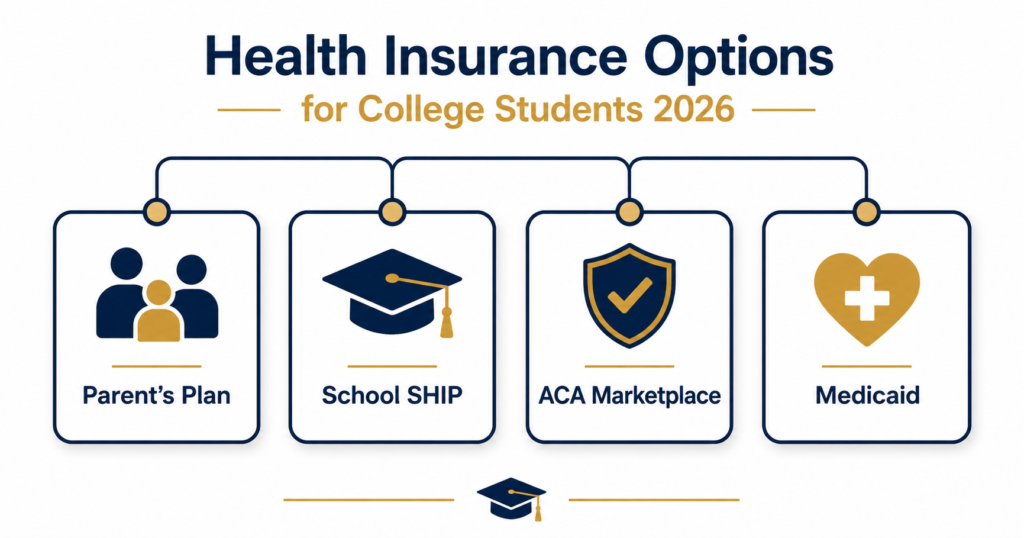
Most students only ever hear about one or two of these. There are actually four main paths, and the right one depends on your age, income, and where your school is located.
1. Staying on a parent’s plan. Under the ACA, you can stay on a parent’s health insurance until you turn 26, regardless of whether you’re a full-time student, married, financially independent, or even still living at home. This remains the cheapest option for most students since there’s usually no extra premium. The catch, the one that got me, is network coverage. If your campus is in a different state or region than your parent’s plan’s network, routine care near school can process as out-of-network, sometimes at a dramatically higher cost.
2. Your school’s Student Health Insurance Plan (SHIP). Many colleges automatically enroll students in their own plan unless you submit a waiver showing you already have qualifying coverage. SHIP premiums typically run $1,800 to $3,600 a year across most major universities, and the plans are usually ACA-compliant, meaning they cover pre-existing conditions and essential health benefits with no annual or lifetime caps. The upside is that SHIP is built entirely around your campus health center, so local care is almost always in-network.
3. ACA Marketplace coverage. If you’re not on a parent’s plan and don’t want SHIP, you can buy your own plan through Healthcare.gov or your state’s marketplace. If your household income (or your own income, if you file independently) falls between roughly 100% and 400% of the federal poverty level, you likely qualify for premium tax credits that meaningfully lower the monthly cost. Open enrollment runs November 1 through January 15, though moving for school or losing other coverage can trigger a Special Enrollment Period outside that window.
4. Medicaid. In states that expanded Medicaid, students earning below 138% of the federal poverty level (based on their own income, not their parents’) can qualify for free coverage with no premium and no deductible. Importantly, student loans, grants, and scholarships do not count as income for Medicaid eligibility, only actual earned income does, which surprises a lot of students who assume their financial aid disqualifies them.
For an official, government-run breakdown of exactly how these four paths interact, Healthcare.gov’s college student coverage page is the most reliable place to double-check your specific situation before deciding.
The Waiver Deadline Nobody Warns You About
If your school auto-enrolls you in SHIP, you can usually waive it by submitting proof of comparable coverage, like a parent’s plan or a marketplace plan, through your student portal. But every school sets its own waiver deadline, often at the very start of each semester, and missing it means you’re stuck paying for SHIP on top of whatever other coverage you already have, sometimes for the entire term.
A friend of mine missed her school’s waiver deadline by four days because she assumed it matched the general tuition payment deadline. It didn’t, and she ended up paying for a SHIP plan she never used for an entire semester. Check your specific school’s deadline directly, don’t assume it lines up with any other academic deadline.
Real Cost Numbers for Health Insurance for College Students
Independent, self-purchased health insurance for college students typically runs somewhere between $272 and $353 a month for a solid Marketplace plan, depending on the metal tier and insurer, according to recent 2026 rate comparisons. Kaiser Permanente tends to offer some of the lowest rates in this range, though it’s only available within its specific service states, while Blue Cross Blue Shield and Ambetter offer broader national networks better suited to students attending school away from home.
If you’re comparing this against your school’s SHIP cost ($1,800-$3,600 annually, or roughly $150-$300 a month averaged out), the numbers can land surprisingly close. The deciding factor usually isn’t price alone, it’s whether the plan’s network actually covers where you’ll be living and studying.
For a deeper comparison across dozens of student health plans and Marketplace options by state, MoneyGeek’s health insurance for college students analysis is worth checking, and eHealthInsurance’s student coverage guide breaks down waiver requirements and enrollment timing clearly if your school’s own paperwork is confusing.
What About International Students?
If you’re studying in the U.S. on an F-1 or J-1 visa, health insurance for college students works a bit differently. Most universities require international students specifically to carry insurance meeting minimum coverage standards, and many schools won’t accept a waiver for international students the same way they would for domestic ones, since visa compliance is often tied directly to maintaining qualifying coverage.
J-1 visa holders in particular often have specific sponsor-mandated insurance requirements written into their visa terms, it’s worth checking with your school’s international student office before assuming any plan, including a cheap private one, will satisfy the requirement.
The Subsidy Cliff Parents Should Know About
Here’s a detail that trips up families more than students realize. If your parents currently claim you as a tax dependent and stop doing so, their household size on paper decreases. If their income stays the same but their household size shrinks, they can suddenly cross the 400% federal poverty level threshold and lose Marketplace subsidies entirely, even though nothing about their actual finances changed.
For a household of four in the continental U.S. in 2026, that subsidy cliff sits around $128,600 in income; for a household of three, it’s about $106,600. If your family is close to that line, it’s worth running the numbers before deciding whether removing a student as a dependent actually saves money overall.
What Happens When You Turn 26
Federal law lets you stay on a parent’s plan until your coverage ends on December 31 of the year you turn 26, even if your birthday falls mid-year. After that, your main options become COBRA (continuing your parent’s exact plan for up to 36 months, but paying the full premium yourself plus an administrative fee), a new Marketplace plan, or employer coverage if you’ve started a job with benefits. Losing dependent coverage triggers a 60-day Special Enrollment Period, miss that window and you may be stuck waiting for the next open enrollment period unless another qualifying event applies.
Common Mistakes I’d Tell Any Student or Parent to Avoid
- Assuming “staying on a parent’s plan” automatically means full coverage at school. Check the provider network for your specific campus zip code before you need care, not after.
- Missing your school’s SHIP waiver deadline. It’s rarely the same date as other academic deadlines, confirm it directly through your student portal.
- Assuming financial aid disqualifies you from Medicaid. Scholarships, grants, and student loans don’t count as income for Medicaid eligibility in most states.
- Not checking international student insurance requirements early. Visa compliance can be tied to specific coverage standards that a generic cheap plan may not satisfy.
- Trying to use 529 funds for health insurance premiums. Health insurance isn’t a qualified education expense under IRS rules, doing this triggers taxes and a 10% penalty on the withdrawal.
- Not planning ahead for turning 26. The transition off a parent’s plan is predictable, start comparing options a couple of months before your coverage ends, not the week after.
Where This Leaves Me Now
That $1,100 urgent care bill eventually got partially reprocessed after I appealed it, but it took months and a lot of phone calls I could have avoided by just checking my provider network before I got sick. These days, checking in-network providers near any new address, school or otherwise, is one of the first things I do, a habit that bill taught me the hard way.
If you’re heading to school soon, or you’re a parent sorting this out for your kid, the extra ten minutes it takes to check network coverage and waiver deadlines is worth it before the semester starts, not after a walk-in clinic visit. If you’re also working through other coverage decisions, I’ve written about my own experience with life insurance, home insurance, car insurance, business insurance, pet insurance, and no medical exam life insurance here on Insurance Pikr too.
For official guidance on subsidies, enrollment periods, and dependent coverage rules, Healthcare.gov remains the most reliable starting point, and healthinsurance.org’s student coverage breakdown is a solid secondary resource for state-specific details.
I write about this kind of practical, real-world insurance stuff regularly over on Insurance Pikr, so if this helped, there’s more where it came from.