
Best Business Insurance in USA 2026: What I Learned After Getting Burned Once
A client tripped over an extension cord in my home studio a few years back. Hit her head on the corner of a desk. Ended up with a mild concussion and an ER bill.
I remember standing there afterward thinking “okay this is fine I have insurance.” Except I didn’t. Not the right kind anyway.
I had a regular homeowner’s policy. It doesn’t cover a single thing that happens inside your home when you’re running a business out of it. My agent told me that over the phone very politely while I stood in my kitchen doing the math on what an ER visit plus a possible lawsuit might cost me.
That was the moment business insurance stopped being “something I’ll get around to” and became something I actually understood.
So I spent the next couple of months comparing quotes reading policy documents I didn’t want to read and asking other small business owners what they wished they’d known sooner. This article is that. Everything I found out written the way I wish someone had explained it to me on day one. I run this stuff regularly over on Insurance Pikr and business insurance is one of the topics I get asked about the most.
Nobody Warns You Until It’s Already Too Late
Here’s the annoying part about business insurance. You don’t feel like you need it until the exact day you desperately do. There’s no slow buildup and no warning email. One slip and fall, one bad storm, one unhappy client with a lawyer and you’re suddenly staring at legal fees that stack up fast whether you win or lose.
Small business data backs this up too. Something like 4 in 10 small businesses face a liability claim within their first decade. That’s not a scare tactic. It’s just what happens when your business touches customers vendors or employees in the real world.
If you want a broader industry snapshot before you start comparing providers yourself, U.S. News has a solid rundown of small business insurance ratings worth skimming.
The Coverage Types That Actually Matter
I’m not going to throw every insurance term at you. Here’s what I personally ended up needing explained the way it was explained to me minus the jargon.
General liability insurance. This is the baseline. Someone gets hurt on your property or you accidentally damage something that belongs to a client and this pays the medical and legal bills. Most commercial landlords won’t hand you the keys without proof of it.
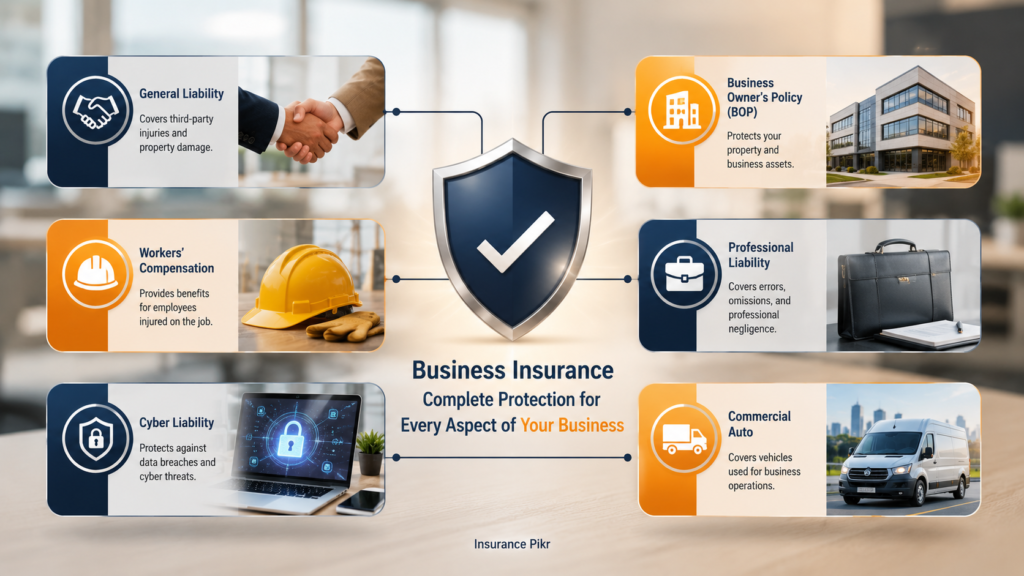
Business Owner’s Policy known as a BOP. This bundles general liability with property coverage for your equipment inventory and physical space into one policy that’s usually cheaper than buying both separately. If you’re small this is probably your starting point.
Workers’ compensation. Required by law in most states the moment you hire even one employee. It covers medical costs and lost wages if they get hurt doing their job. Skipping it isn’t just risky. It can get your business fined or shut down.
Professional liability also called errors and omissions or E&O. If your business gives advice or delivers a service like consulting design bookkeeping or coaching this covers you if a client claims your work cost them money. A friend running a small marketing agency learned this one the hard way when a client sued over a campaign that “didn’t perform as promised.” General liability didn’t touch it. Her E&O policy did.
Cyber liability insurance. If you store customer info of any kind, even just names and emails in a tool like Mailchimp, this is worth pricing out. Small businesses get targeted precisely because they’re usually less protected than big companies.
Commercial auto insurance. Your personal car policy will not cover an accident that happens while you’re working even a short delivery run. If anyone drives for the business this matters.
Insureon has a decent breakdown of how small businesses typically buy these policies if you want a second opinion on which combination fits your setup.
What I’d Actually Recommend Looking At
I got quotes from several providers before I landed on a policy. Here’s the honest rundown with no fluff.
The Hartford shows up again and again as a strong overall pick especially for home based or client facing businesses. Their claims process has a solid reputation and their BOP coverage is broad.
Hiscox is built for freelancers consultants and small teams. My application took under fifteen minutes online and I liked that they let you pay monthly with no extra fee. That mattered when cash flow was tight in year one.
Nationwide has a genuinely wide range of coverage including surety bonds though it’s worth double checking it’s available in your state first since it isn’t everywhere.
Travelers automatically bundles professional liability into their BOP which saved me from buying a separate policy for that.
NEXT Insurance is fully digital. You get a quote purchase a policy and download a certificate of insurance all through their website or app with no agent required. Good option if you’re small and just need something fast.
Progressive is the name to check if vehicles are part of your business, deliveries service calls or mobile work. They’re the largest commercial auto insurer in the country and it shows in the pricing.
None of these is “the best” across the board. It comes down to your industry your team size and honestly what’s actually kept you up at night. NavSav put together a useful guide on choosing coverage by business type that’s worth a look if your business doesn’t fit neatly into one category.
What This Actually Costs
Here’s the real range I found while shopping around, not some marketing friendly “starting at” number.
- General liability alone: roughly $30 to $70 a month for a small operation
- A basic BOP: roughly $50 to $150 a month depending on industry and coverage limits
- Workers’ comp: varies a lot by state and industry risk but budget at least $50 to $100 a month per employee for lower risk work
- Professional liability: roughly $40 to $100 a month depending on your field
Your actual number will depend on your industry revenue location and claims history. A hair salon and a freelance software consultant with similar revenue will get very different quotes because the risk each one carries is completely different. Investopedia’s cost breakdown on their small business insurance guide lines up pretty closely with what I actually paid, so it’s a fair benchmark if you want to sanity check a quote you’ve received.
Mistakes I Made So You Don’t Have To
I assumed my homeowner’s policy covered my home business. It didn’t. Most don’t. Call your insurer directly and ask. Don’t assume.
I only got one quote the first time around. Rookie move. When I finally compared three providers side by side the same coverage varied by almost 40% in price.
I under insured my equipment. I priced my laptop and camera gear at what I originally paid for them years earlier not what they’d actually cost to replace today. When I filed a claim the payout came in lower than I expected because of that gap.
I skipped the exclusions page. Every policy has one listing exactly what it won’t cover. Read it before you buy not after you need to file something.
A Simple Starting Point If You’re Beginning From Zero
- List your actual risks honestly. Physical location, employees, client data, vehicles, the works.
- Decide if a BOP covers most of that or if you need extra standalone policies layered on top.
- Get quotes from at least three providers. Don’t skip this part.
- Check each company’s AM Best financial strength rating so you know they can actually pay a large claim.
- Ask every provider about bundling discounts before you commit.
- Set a reminder to reread your policy every year especially after any big change in the business.
Final Thoughts
Business insurance isn’t exciting to think about let alone shop for. Nobody starts a business dreaming about their liability coverage. But the one time you actually need it, it’s the difference between a rough week and losing everything you’ve spent years building.
I’d rather pay a manageable monthly premium now than have another kitchen floor moment doing math on an ER bill I wasn’t ready for.
If you’re also sorting out coverage on the personal side, I’ve written up the best life insurance options for 2026, the best home insurance policies for 2026 and the best health insurance plans in the USA for 2026 here on Insurance Pikr.
For official unbiased guidance, the U.S. Small Business Administration’s insurance page is worth a read and the National Association of Insurance Commissioners lets you check a provider’s complaint history before you commit to anything.
Frequently Asked Questions
Do I legally need business insurance? Depends on your state and industry. Workers’ compensation is required almost everywhere once you have employees. General liability usually isn’t legally mandatory but most leases and client contracts will ask for proof of it anyway.
What’s the best business insurance for an LLC? An LLC protects your personal assets from business debts but it won’t pay a lawsuit settlement or a repair bill. That’s still on your insurance. A BOP covering general liability and property is usually the right first move for most LLCs.
What’s the best business insurance for a startup? Digital first insurers like NEXT tend to work well early on when you need fast online coverage without dealing with an agent. As you grow and start hiring, providers like The Hartford or Hiscox tend to scale better with more complex needs.
Can I get business insurance the same day I need it? Often yes. Several providers now offer instant online quotes and same day certificates of insurance which comes in handy when a client or landlord wants proof of coverage before you can even start the job.