
Non-Owner Car Insurance
Non-Owner Car Insurance: What I Learned After Selling My Car and Still Needing to Drive
I sold my car when I moved to a city with decent public transit, feeling genuinely smug about cutting a major expense out of my life. Then a friend asked me to drive her car to the airport while she was out of town, and I froze, realizing I had zero insurance coverage of my own if anything went wrong behind the wheel of a car that wasn’t mine.
That moment sent me looking into non-owner car insurance, something I’d never needed to think about while I actually owned a vehicle. It turned out to be one of the more useful, and more misunderstood, corners of auto insurance, cheap, genuinely valuable in specific situations, and completely wrong for others. Here’s everything I actually learned working through it.
I’ve already covered general auto insurance strategy in my best car insurance guide and the teen driver angle in my car insurance for teenage drivers guide here on Insurance Pikr. This one is specifically about non-owner car insurance, who actually needs it, what it costs in 2026, and where people misunderstand what it does and doesn’t cover.
What Non-Owner Car Insurance Actually Is
Non-owner car insurance is a liability-only policy for people who drive occasionally but don’t own a vehicle registered in their name. It covers bodily injury and property damage you cause to others while driving a borrowed or rented car, but it does not cover damage to the vehicle you’re driving, and it doesn’t cover your own injuries either. Think of it as protection tied to you as a driver, not to any specific car.
A typical non-owner car insurance policy costs around $46 a month nationally, according to recent Insurify rate data, noticeably cheaper than a standard policy since there’s no vehicle attached to insure for collision or comprehensive damage.
Who Actually Needs Non-Owner Car Insurance
This coverage makes sense in a fairly specific set of situations, and it’s genuinely unnecessary outside of them:
- You regularly borrow cars from friends or family but don’t live in the same household as the vehicle’s owner. If you do live together, being added to their existing policy is usually the better route instead.
- You rent cars frequently, for work travel or otherwise, and want to avoid repeatedly paying for the rental counter’s daily liability coverage.
- You want to maintain continuous insurance coverage even without currently owning a car, since a lapse in coverage history can raise your rates later when you do buy a vehicle again.
- You need to file an SR-22 to reinstate a suspended license but don’t own a car, covered in more detail below.
If you own a vehicle, live with someone whose car you regularly drive, or specifically need coverage for damage to the car itself, non-owner car insurance isn’t the right fit, a standard policy or being added to an existing household policy makes more sense in those cases.
Non-Owner Car Insurance and SR-22 Filings
This is where things get more specific, and more expensive. If you’ve had your license suspended, typically after a DUI, reckless driving charge, or multiple violations, your state may require an SR-22 certificate proving you carry the state minimum liability coverage before your license is reinstated. If you don’t own a car at the time, a non-owner SR-22 policy satisfies that requirement.
Real 2026 cost data shows non-owner SR-22 insurance averaging around $574 to $631 a year nationally, though the range is wide. GEICO currently offers the cheapest non-owner SR-22 coverage among national carriers at roughly $481 a year ($40 a month), with Travelers close behind at $520 a year. USAA comes in even lower at $232 a year, but it’s restricted to military members and their families.
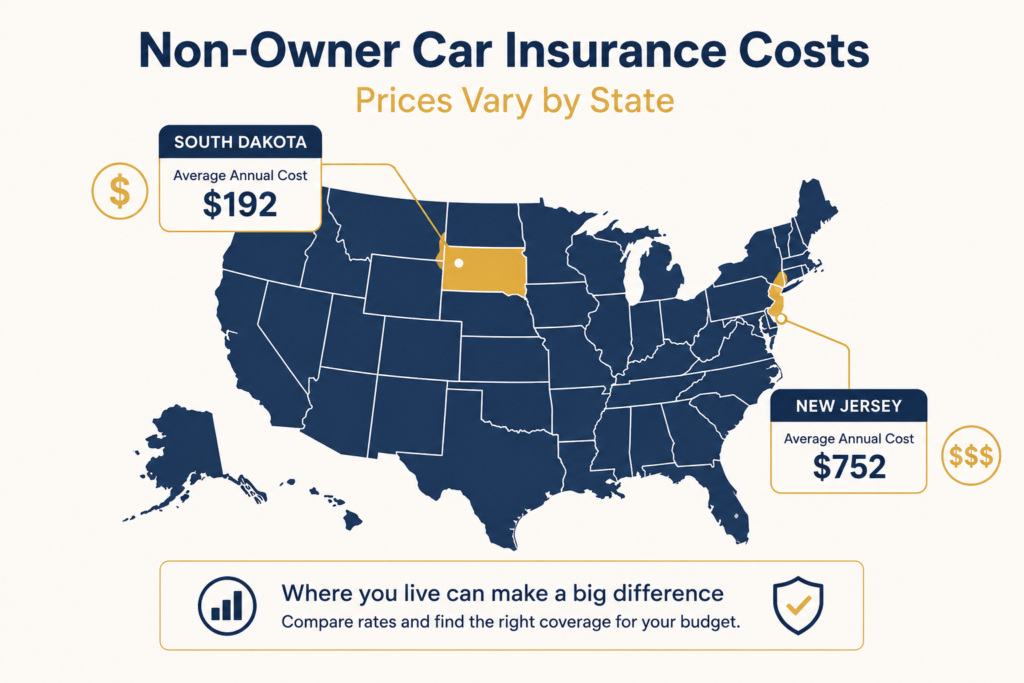
State matters enormously here too. South Dakota drivers pay as little as $262 a year for non-owner SR-22 coverage, while New Jersey drivers can pay upward of $1,487 a year for the exact same type of filing, based on 2026 rate analysis across all 50 states.
What Non-Owner Car Insurance Actually Costs by Situation
| Situation | Typical Annual Cost | Typical Monthly Cost |
|---|---|---|
| Standard non-owner policy (clean record) | ~$552 | ~$46 |
| Non-owner SR-22, clean record aside from lapse | ~$360 | ~$30 |
| Non-owner SR-22, national average | $574-$631 | ~$48-$53 |
| Non-owner SR-22, DUI or serious violation | $900-$1,800+ | $75-$150+ |
| Cheapest national carrier (GEICO, SR-22) | $481 | $40 |
(Rates vary significantly by state, driving record, and violation type. The SR-22 filing fee itself is separate and typically runs $15-$25, on top of the policy premium.)
What Non-Owner Car Insurance Does Not Cover
This is the part that trips people up most. Non-owner car insurance is liability-only, meaning it pays for injuries or damage you cause to other people or their property. It does not include collision or comprehensive coverage, so if you damage the borrowed or rented car itself, this policy won’t pay for those repairs. If you frequently drive a specific vehicle you don’t own, it’s worth asking the vehicle’s owner about adding you to their existing comprehensive policy instead, since non-owner coverage was never designed to protect the car you’re driving.
Common Mistakes People Make With Non-Owner Car Insurance
- Assuming it covers damage to the car you’re driving: It doesn’t, non-owner car insurance is strictly liability-only, repairs to a borrowed or rented vehicle are not included.
- Letting an SR-22 filing lapse: If a non-owner SR-22 policy lapses, most states report this to the DMV, which can suspend your license again or restart your required filing period entirely.
- Not shopping around for SR-22 rates: The gap between insurers, and between states, is large enough that comparing quotes directly can save hundreds of dollars a year for identical coverage.
- Buying a standard policy when you don’t own a car at all: Standard policies require a vehicle to be listed on them, non-owner coverage exists specifically to fill this gap.
- Assuming every insurer offers non-owner policies: Many major carriers don’t write this type of coverage at all, it’s worth confirming directly rather than assuming your usual insurer offers it.
- Ignoring how long an SR-22 requirement lasts: Most states require the filing to stay active for about three years, letting coverage lapse during that window can reset the clock entirely.
Where This Leaves Me Now
I ended up getting a standard non-owner policy shortly after that airport drive, mostly for the peace of mind of knowing I was actually covered the next time a friend needed a favor behind the wheel. It’s one of those quiet, inexpensive policies that matters enormously in the one specific moment you actually need it, and costs almost nothing the rest of the time.
If you’ve sold a car, moved somewhere you don’t need one daily, or occasionally borrow or rent vehicles, it’s worth the ten minutes it takes to get a non-owner car insurance quote before you’re caught without coverage the way I nearly was. If you’re also working through other coverage decisions, I’ve written about my own experience with life insurance, home insurance, health insurance, and pet insurance here on Insurance Pikr too.
For state-specific quotes and current SR-22 requirements, CarInsurance.com’s non-owner SR-22 guide and Insurify’s non-owner car insurance breakdown are both solid, current places to check real numbers before you buy.
I write about this kind of practical, real-world insurance stuff regularly over on Insurance Pikr, so if this helped, there’s more where it came from.