
Car Insurance for Teenage Drivers in 2026: The Quote That Made Me Reread It Twice

My son passed his road test on a Tuesday. By Thursday, I’d added him to our policy and stared at the new premium for a solid minute, certain there had been some kind of billing error. There wasn’t. Our annual rate had jumped by thousands of dollars, more than doubling what we paid before he got his license.
I called around, compared quotes, and asked every discount question I could think of, and I still ended up paying significantly more than before. But I paid a lot less than I would have if I hadn’t shopped around, and a lot less than families who insure their teen on a separate standalone policy instead of adding them to the parent plan. Here’s everything I actually learned working through car insurance for teenage drivers this year.
I’ve already covered general auto insurance strategy in my best car insurance guide here on Insurance Pikr. This one is specifically for parents going through this exact moment, the real 2026 numbers, what actually moves the price, and where families waste money without realizing it.
Table of Contents
- Why Car Insurance for Teenage Drivers Costs So Much
- Real 2026 Cost Numbers by Age
- Add to Your Policy or Get a Separate One?
- Discounts That Actually Move the Needle
- How Much Location Changes Everything
- What an Accident or Ticket Actually Costs
- Common Mistakes I’d Tell Any Parent to Avoid
- Where This Leaves Me Now
Why Car Insurance for Teenage Drivers Costs So Much
Insurers price risk based on data, and teen drivers, especially 16 and 17-year-olds, have the highest crash rate of any age group on the road. Without a driving history to individually assess, insurers charge more across the board to cover that statistical uncertainty. It’s not personal, it’s just how the pricing model works, and it applies to every family adding a new teen driver, regardless of how careful that specific teenager actually is.
Real 2026 Cost Numbers by Age for Car Insurance for Teenage Drivers
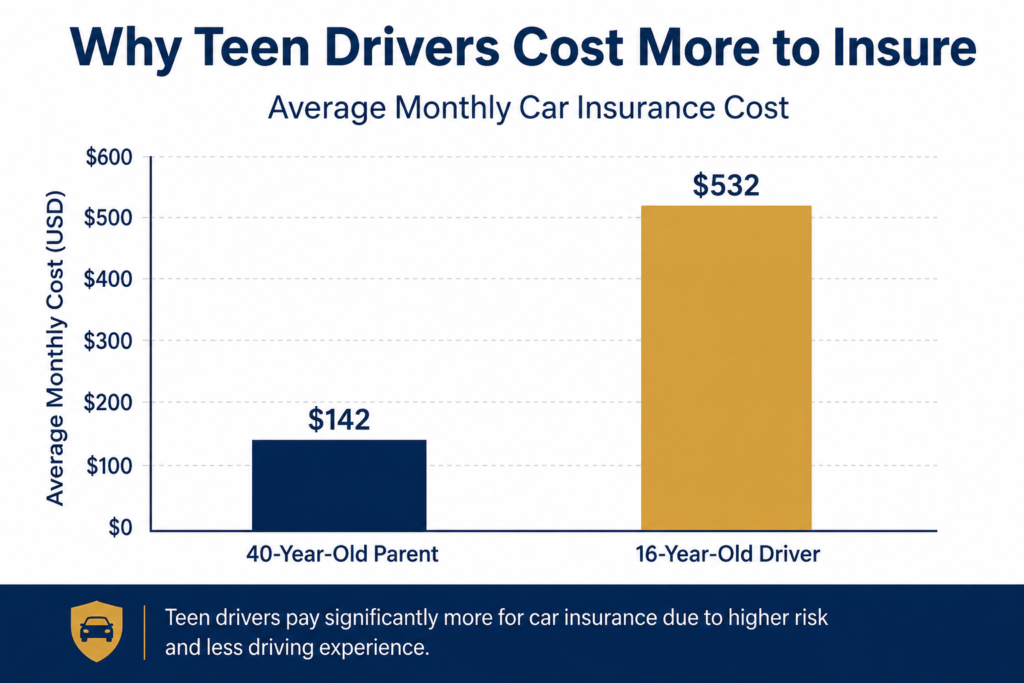
Here’s what recent 2026 data actually shows, pulled from multiple rate analyses:
| Driver Profile | Monthly Cost (Full Coverage) | Annual Cost |
|---|---|---|
| 16-year-old added to parent policy | ~$270 added to existing premium | $4,050-$5,740 more/year |
| 16-year-old, standalone full coverage | $436 (female) / $478 (male) | $5,232-$5,736 |
| 17-year-old, national average | ~$715 (female) / ~$800 (male) | $8,583 (female) / $9,607 (male) |
| 18-year-old, standalone policy | ~$634 | ~$7,611 (male average) |
| 40-year-old parent (for comparison) | ~$213 | ~$2,552-$2,575 |
Adding a teen to an existing family policy is consistently the cheaper route compared to a standalone policy in a teen’s own name, in most states, teens legally can’t even hold their own policy unless emancipated. The gap between “added to parent policy” and “standalone” can run into thousands of dollars a year for identical coverage.
Add to Your Policy or Get a Separate One?
For nearly every family, adding your teen to your existing policy costs less than a standalone policy would, since insurers spread the higher risk across the household rather than pricing a brand-new driver in isolation. Standalone policies exist mainly for older teens who’ve moved out or emancipated minors, situations that are the exception rather than the rule.
If you’re weighing whether it’s worth shopping insurers before or after your teen gets their permit, do it before. Getting quotes while your teen still has a learner’s permit gives you time to compare options without the pressure of a policy that needs to be active the day they get licensed.
Discounts That Actually Move the Needle
A few discounts consistently make a real difference for car insurance for teenage drivers:
- Good student discount: Typically requires a B average or better and proof via report card or transcript, renewed each term. This can shave 8-16% off the premium depending on the carrier, worth $500-$700 a year on a typical policy.
- Telematics/usage-based programs: Apps that track actual driving behavior (braking, speed, phone use) can lower rates for genuinely safe teen drivers, sometimes more effectively than age-based pricing alone.
- Choosing the right car: A vehicle with strong safety ratings and a lower market value costs meaningfully less to insure than something powerful or expensive. In 2026, vehicles like the Honda CR-V and HR-V rank among the cheapest to insure overall.
- Driver’s education course completion: Many states and insurers offer a discount for completing an approved driver’s ed program, on top of what’s often already legally required for a teen’s license.
- Bundling home and auto insurance with the same company, something I’ve also covered in my home insurance guide, can offset part of the increase from adding a teen driver.
For a deeper breakdown of exactly which companies offer the strongest teen driver discounts, CNBC Select’s best car insurance for teens ranking compares affordability, coverage options, and customer satisfaction data across two dozen insurers.
How Much Location Changes Car Insurance for Teenage Drivers
State matters more than most parents expect. In Louisiana, parents pay an average of nearly $11,000 to over $12,000 annually with a teen added to the policy. In Vermont, the same coverage averages roughly $4,600 to $5,100. That’s close to a $9,700 annual swing for functionally identical coverage, purely based on state, according to recent MoneyGeek rate analysis. Louisiana, Florida, and New Jersey consistently rank among the most expensive states for teen drivers, while Hawaii, Maine, and Vermont rank among the most affordable.
If you’re deciding between insurers, MoneyGeek’s teen car insurance cost breakdown and Insurify’s cheapest car insurance for teenagers guide both let you compare real-time quotes by state rather than relying on national averages that may not reflect your actual ZIP code.
What an Accident or Ticket Actually Costs
This part is worth sitting your teen down for directly. A single at-fault accident adds roughly $2,082 a year to a teen’s premium. A speeding ticket adds around $1,207 a year. A DUI adds approximately $4,235 a year. These increases typically stay on a policy for three to five years, meaning one serious incident at 16 can cost a family well over $10,000 in additional premiums by the time that violation finally drops off.
Even a not-at-fault accident can raise rates by an average of $200 a year, since insurers view any accident involvement as a data point, regardless of who was legally responsible.
Common Mistakes I’d Tell Any Parent to Avoid
- Waiting until your teen is already licensed to get quotes. Shop while they still have a learner’s permit, so you’re not scrambling the week they pass their test.
- Assuming a standalone policy is ever cheaper. For nearly every family, it isn’t, adding a teen to the existing household policy is almost always the lower-cost path.
- Ignoring the good student and telematics discounts. These are genuinely some of the largest discounts available and require minimal effort to qualify for.
- Letting your teen drive an expensive or high-performance car. The car itself meaningfully affects the premium, a safer, lower-value vehicle can save real money every single month.
- Not comparing multiple insurers. Rates for the exact same teen driver profile can vary enormously between companies, get at least 3-4 quotes before deciding.
- Underestimating the real cost of a single violation. One at-fault accident or DUI can follow a teen’s record for years, costing far more than the incident itself.
Where This Leaves Me Now
Our premium is still higher than it was before my son got his license, that part never fully goes away. But between the good student discount, a telematics program, and shopping around instead of just accepting our existing insurer’s renewal quote, we’re paying meaningfully less than we would have otherwise, and a lot less than a standalone policy would have cost.
If you’ve got a teen approaching driving age, start the insurance conversation before the road test, not after. If you’re also working through other coverage decisions around this same life stage, I’ve written about my own experience with life insurance, health insurance, business insurance, and pet insurance here on Insurance Pikr too.
For state-specific rate comparisons and current 2026 data, U.S. News’ average cost of car insurance analysis is a solid, unbiased place to check numbers specific to your family’s situation before renewing or switching insurers.
I write about this kind of practical, real-world insurance stuff regularly over on Insurance Pikr, so if this helped, there’s more where it came from.