
Group Life Insurance vs Individual Life Insurance: The Layoff That Made Me Realize My Coverage Was Gone

I found out I’d been laid off on a Friday afternoon, and it wasn’t until that weekend, doing the math on what my family would actually need to manage without me, that I realized something worse: the life insurance I thought I had through work had disappeared the moment my employment ended. I’d been mentally counting on it for three years without ever reading the fine print.
That gap between what I assumed and what was actually true is exactly where group life insurance vs individual life insurance stops being an abstract comparison and becomes something that actually matters. Both are real coverage, but they work fundamentally differently, and the difference only becomes obvious at the worst possible moment, when you’ve already lost the job that came with it.
I’ve already covered general life insurance basics in my life insurance guide, the fast-approval route in my no medical exam life insurance guide, and the senior-specific angle in my life insurance for seniors guide here on Insurance Pikr. This one is specifically about group life insurance vs individual life insurance, what actually happens when you leave a job, and why relying on one alone usually leaves a real gap.
The Core Difference in Group Life Insurance vs Individual Life Insurance
Group life insurance is a policy your employer purchases as a single master contract covering all eligible employees. You receive a certificate of coverage, but you don’t own the policy, your employer does, and the underwriting is minimal since risk is spread across the entire group rather than assessed person by person. This is exactly why group coverage typically requires no medical exam and comes at little or no direct cost to you.
Individual life insurance is a private contract between you and an insurance company. You choose the death benefit, the term length, and the beneficiary, and the policy is yours regardless of where you work or whether you’re employed at all. Underwriting is more thorough, usually including health questions and sometimes a medical exam, but the coverage stays with you permanently once issued.
Why Group Life Insurance vs Individual Life Insurance Comes Down to Ownership
The single most important distinction isn’t cost or coverage amount, it’s ownership. Nearly two-thirds of working adults who currently own life insurance obtained it through their workplace, according to Guardian’s 2026 employer life insurance data, which means most people’s primary coverage is something they don’t actually control or keep if their employment situation changes.
What Group Life Insurance vs Individual Life Insurance Actually Costs
| Factor | Group Life Insurance | Individual Life Insurance |
|---|---|---|
| Typical cost to employee | Often free (basic coverage) or low payroll deduction | $20-$60+/month depending on age, health, coverage |
| Coverage amount | 1-2x annual salary (basic), up to 3-4x with supplemental | $100,000 to $1.5 million+, fully customizable |
| Medical exam required | Rarely, guaranteed issue for basic coverage | Usually yes, unless using no-exam underwriting |
| Portable if you leave your job | No, unless conversion or portability option is used | Yes, always, coverage isn’t tied to employment |
| Tax treatment | First $50,000 tax-free; coverage above that is taxable “imputed income” | Death benefit generally tax-free regardless of amount |
(Individual policy costs vary significantly by age, health, and coverage amount, healthy applicants in their 30s often pay less than group supplemental rates by their 50s, since group premiums increase sharply in five-year age bands.)
The Coverage Gap Almost Nobody Talks About
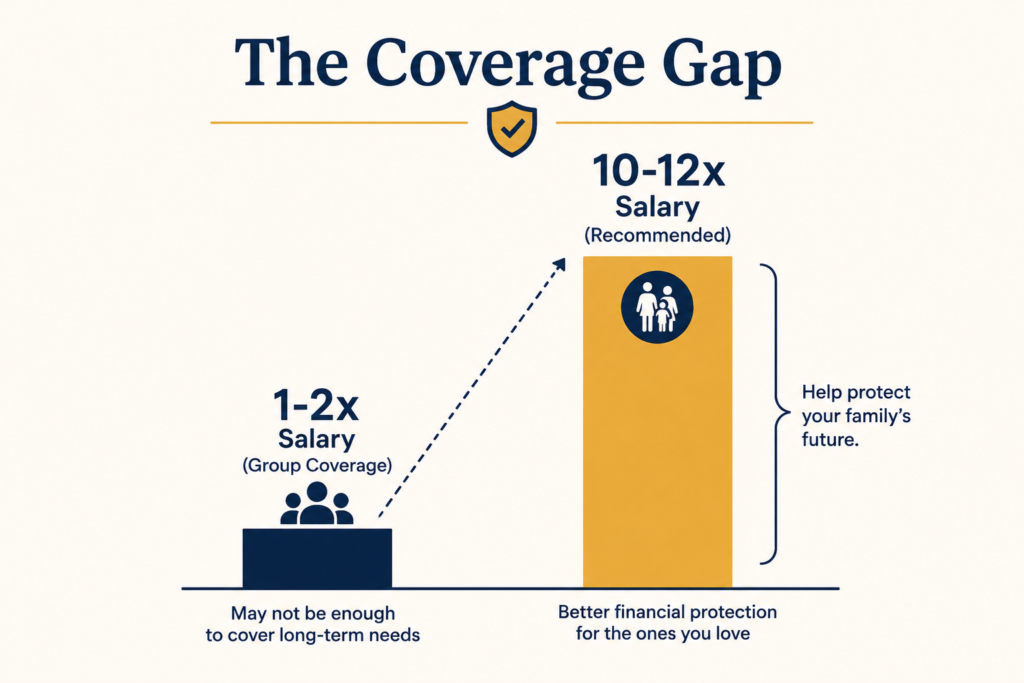
This is the part that surprised me most while working through this. Financial experts generally recommend life insurance coverage equal to 10-12 times your annual income, but 95% of employers only offer group coverage equal to 1-2 times salary. That gap is enormous, and it means most people relying solely on group life insurance vs individual life insurance as their only safety net are significantly underinsured without realizing it.
Some employers offer supplemental group coverage up to 3-4 times salary through payroll deduction, but even that rarely closes the full gap financial planners typically recommend.
What Happens to Group Life Insurance When You Leave Your Job
Here’s exactly what caught me off guard. Group coverage almost always ends the moment your employment ends, whether through a layoff, resignation, or retirement. Some employers offer two ways to keep coverage going:
Conversion lets you switch your group term coverage into an individual permanent policy without new medical underwriting, valuable if you have health conditions that would make qualifying for a new policy difficult. The tradeoff is real: conversion premiums typically increase 200-400% compared to what you were paying through the group plan, and coverage amounts are usually limited to what was terminating.
Portability lets you continue similar term coverage on your own, often at a lower cost than conversion, but premiums still increase with age similar to a standard renewable term policy, and ported coverage typically only continues until age 70 or 80 depending on the carrier.
Both options usually require action within a strict window, commonly 31 days from your termination date, miss that deadline and you may lose the option entirely unless you received insufficient notice, in which case some protections under ERISA may extend your window.
The Tax Detail Most Employees Never Check
If you have supplemental group life insurance through work, this is worth knowing before your next open enrollment. The IRS excludes the first $50,000 of employer-provided group term life insurance from your taxable income entirely. Anything above that $50,000 threshold gets taxed as “imputed income,” calculated using the IRS Premium Table I based on your age, meaning older employees with higher supplemental coverage amounts can see a real, if small, bump in their taxable income each year that individual life insurance simply doesn’t create.
When Combining Group Life Insurance and Individual Life Insurance Makes the Most Sense
For most people, the strongest approach isn’t choosing one over the other, it’s using both together. Accept free or low-cost group coverage as a baseline, since there’s little downside to coverage your employer is already paying for, and layer a portable individual policy on top to cover the real gap between what group insurance provides and what your family would actually need.
This matters even more for anyone over 50. The Society for Human Resource Management has noted that group life premiums for employees over 50 can triple compared to younger workers within the same plan, which is exactly the point where locking in an individual policy earlier, while healthy and younger, often ends up meaningfully cheaper over time than relying on aging group rates alone.
Common Mistakes People Make With Group Life Insurance vs Individual Life Insurance
- Assuming group coverage follows you to a new job. It almost never does, coverage typically ends the day your employment ends, regardless of how long you were there.
- Not checking the conversion or portability deadline. These windows are short, often just 31 days, missing it can mean losing the option to keep any coverage at all without new underwriting.
- Relying entirely on group coverage as your only policy. With most employer plans capping at 1-2 times salary against a recommended 10-12 times, the gap is usually significant.
- Assuming supplemental group coverage is always tax-free. Anything beyond the first $50,000 becomes taxable imputed income, worth checking your specific coverage amount against that threshold.
- Waiting until a layoff to think about individual coverage. Shopping for an individual policy while still employed and healthy is almost always cheaper and faster than doing it under pressure after losing group coverage.
- Assuming conversion and portability cost the same. Conversion premiums can run 200-400% higher than your group rate, portability is often the more affordable bridge if you qualify for it.
Where This Leaves Me Now
I ended up converting part of my group coverage and adding a separate individual term policy once I landed my next job, specifically so I’d never again be entirely dependent on whatever my employer happened to offer. That Friday layoff turned into the push I needed to actually understand group life insurance vs individual life insurance instead of just assuming one meant I was covered.
If you’re currently relying only on whatever your employer provides, it’s worth checking your actual coverage amount against what your family would realistically need, before a layoff forces that math on you the way it did for me. If you’re also working through other coverage decisions, I’ve written about home insurance, health insurance, business insurance, and pet insurance here on Insurance Pikr too.
For a deeper breakdown of conversion, portability, and employer coverage rules, Guardian’s 2026 employer guide to life insurance and Western & Southern’s group vs individual life insurance comparison are both solid, current places to check details specific to your situation.
I write about this kind of practical, real-world insurance stuff regularly over on Insurance Pikr, so if this helped you catch a gap in your own coverage, there’s more where it came from.