
Home Insurance for Wildfire Areas: The Renewal Letter That Turned Into a 740% Increase
A homeowner near Idaho Springs, Colorado opened his renewal notice expecting the usual modest bump. Instead, his premium had jumped from $4,677 to $34,600 in a single renewal cycle, a 740% increase, for the same house, the same roof, the same claims-free history he’d had for years. He hadn’t done anything wrong. His zip code had simply been re-scored.
Stories like that aren’t rare anymore, they’re becoming the defining story of home insurance for wildfire areas across the entire American West. If you live anywhere near wildland vegetation in California, Colorado, Oregon, Washington, Arizona, or Utah, understanding what’s actually happening to this market in 2026, and what you can still do about it, matters more than almost any other insurance decision you’ll make this year.
I’ve already covered general home insurance strategy in my best home insurance policy guide and the first-time buyer angle in my home insurance for first-time homebuyers guide here on Insurance Pikr. This one is specifically about home insurance for wildfire areas, the real numbers by state and city, and the moves that are actually helping homeowners keep coverage in 2026.
Why Home Insurance for Wildfire Areas Changed So Fast
Between 2017 and 2025, wildfires caused more than $30 billion in insured losses in California alone. The January 2025 Los Angeles wildfires generated an estimated $4 billion in losses for California’s FAIR Plan alone, forcing the plan to assess its member insurance companies $1 billion just to cover claims. That single event reshaped pricing and availability across the entire western United States, not just California.
Reinsurance, essentially insurance that insurance companies buy for themselves, has roughly tripled in cost for wildfire exposure over the past few years, and carriers are passing that cost directly to homeowners. Combine that with rebuilding costs that jumped 35-50% in states like Colorado between 2020 and 2024, and you get a market where insurers are pulling back faster than most homeowners can adjust to.
Which States Have the Highest Wildfire Insurance Risk
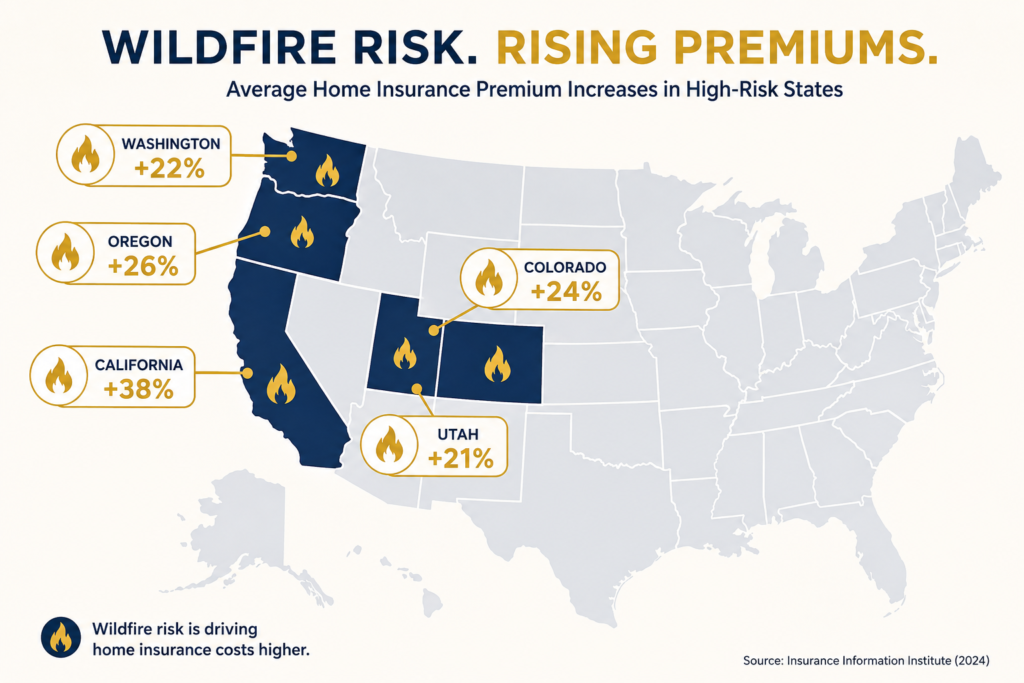
Insurify and multiple state insurance departments currently flag Arizona, California, Colorado, Oregon, Washington, Utah, and Idaho as the highest-risk states for wildfire-related home insurance issues, including non-renewals, coverage restrictions, and separate deductibles specific to fire damage.
Real 2026 Costs for Home Insurance for Wildfire Areas by State
| State/Region | Avg. Annual Premium (Standard Coverage) | High-Risk Zone Premium | Recent Trend |
|---|---|---|---|
| California (statewide) | ~$1,480 (admitted market) | $5,000-$25,000+ | FAIR Plan grew 44% in one year |
| California FAIR Plan | $3,000-$3,200 | Up to $32,000 in extreme ZIPs | 29.1% rate hike approved for 2026 |
| Colorado (statewide) | $4,072 | $8,000-$10,000+ (Boulder foothills) | 6th most expensive state, up 58% since 2018 |
| Oregon | National average + ~27% since 2020 | Varies by WUI zone | New mitigation-discount bill proposed 2026 |
| Utah (Wasatch Front/Park City) | Rising sharply | Non-renewals increasing | New statewide risk-mapping law (HB 48) starting 2026 |
(WUI stands for wildland-urban interface, areas where homes border undeveloped vegetation, the specific zone insurers weight most heavily when scoring wildfire risk.)
Cities and Regions Facing the Steepest Changes
Los Angeles County, California has seen major carriers pull back from specific neighborhoods including Brentwood, Hollywood, and Highland Park, pushing more homeowners toward the FAIR Plan or surplus-lines coverage paired with a Difference-in-Conditions (DIC) wrap.
Boulder County and the I-70 corridor, Colorado routinely see premiums exceed $8,000-$10,000 annually, with some mountain properties facing increases of 150-300% in a single renewal.
The Sierra foothills near Fresno and rural areas outside Modesto, California fall squarely within Fire Hazard Severity Zones, where roughly 41% of homes in the highest-risk ZIP codes now carry FAIR Plan coverage, up from about 4% in lower-risk areas of the same state.
Washington County and the Wasatch Back, Utah, including areas near Park City, have been flagged among the riskiest in the nation for wildfire, with homeowners facing non-renewals or premiums many can no longer afford.
Southern Oregon’s WUI communities have seen premiums rise more than 27% since 2020 alone, prompting new state legislation modeled directly on Colorado’s mitigation-discount approach.
Want to see where your own zip code stands? Check it below.
Wildfire Home Insurance Lookup
Enter a U.S. zip code to see 2026 wildfire risk and home insurance data for your state.
What the FAIR Plan Actually Is (And What It Doesn’t Cover)
When private insurers won’t write a policy, most western states offer a FAIR Plan, an insurer of last resort funded by participating insurance companies. It’s genuinely useful for keeping mortgage-required coverage active, but it comes with real limitations. California’s FAIR Plan, for example, caps coverage at $3 million and only covers fire, lightning, and internal explosion, it does not include theft, liability, or water damage.
This is why most FAIR Plan policyholders also need a separate Difference-in-Conditions (DIC) policy, which wraps around the FAIR Plan to restore liability, theft, water damage, and loss-of-use coverage that a fire-only policy leaves out entirely. Without this wrap, most mortgage lenders won’t consider FAIR Plan coverage sufficient at closing.
Mitigation Discounts Actually Worth Pursuing in 2026
This is genuinely the most useful lever homeowners have right now, and it’s newer than most people realize. California’s wildfire hardening discount program, launched November 2025, offers up to 16.4% off the wildfire portion of a premium when all twelve qualifying hardening measures, Class A roofing, ember-resistant vents, defensible space clearance, are documented and verified.
Colorado’s House Bill 1182, effective July 1, 2026, now legally requires insurers to recognize and reward documented wildfire mitigation work when setting rates, the most significant piece of wildfire insurance legislation in the state’s history. Oregon and Utah have both introduced similar mitigation-based legislation in 2026, modeled directly on Colorado’s approach, signaling this is becoming the standard regulatory response across the region rather than an isolated policy.
What Actually Helps If You’ve Been Non-Renewed
If you’ve received a non-renewal notice, a few things genuinely move the needle. Remarketing your policy 60-90 days before renewal, rather than waiting until the last minute, gives brokers more room to shop admitted carriers, surplus-lines markets, and the FAIR Plan together instead of defaulting straight to the most expensive option. Documented mitigation work under state-specific programs can move a property back up the coverage ladder, sometimes from genuinely uninsurable back to admitted-market eligible. And checking whether your state requires advance notice before a rate increase or non-renewal, several states now mandate 60 days notice minimum, gives you real time to act instead of scrambling.
Some carriers are also beginning to re-enter these markets deliberately. California’s reform package is specifically designed to bring major carriers like State Farm, Allstate, and USAA back into wildfire-prone areas over 2026 and 2027, though the practical impact is still unfolding state by state.
Common Mistakes Homeowners Make With Home Insurance for Wildfire Areas
- Waiting for a non-renewal notice before shopping around: Remarketing proactively, well before your renewal date, gives you far more options than reacting after a cancellation letter arrives.
- Assuming a FAIR Plan policy alone satisfies your mortgage requirement: It almost never does on its own, most lenders require a DIC wrap alongside it for full coverage.
- Skipping documented mitigation work: With new laws in Colorado, and similar proposals in Oregon and Utah, mitigation now has a direct, legally required path to lower premiums that didn’t exist a few years ago.
- Not checking your state’s specific wildfire risk mapping tool: States like Utah now require insurers to use standardized risk maps, understanding your exact score helps you know what you’re actually being priced against.
- Assuming all wildfire-prone states work the same way: California, Colorado, Oregon, and Utah each have different FAIR Plan structures, different mitigation programs, and different notice requirements, don’t assume rules from one state apply in another.
- Underestimating rebuilding cost increases: With construction costs up 35-50% in states like Colorado since 2020, dwelling coverage limits that felt adequate a few years ago may now leave you significantly underinsured.
Where This Leaves Homeowners Now
The homeowner near Idaho Springs eventually found coverage again, but only after mitigation work, a broker who shopped multiple markets, and a FAIR Plan policy paired with a DIC wrap, exactly the path more western homeowners are being pushed toward every renewal cycle. Home insurance for wildfire areas isn’t optional anymore in these regions, it’s become one of the most active, fastest-changing corners of the entire insurance market.
If you’re in a wildfire-prone zip code and your renewal is coming up, start the remarketing process now rather than waiting for a letter to force your hand. If you’re also working through other coverage decisions, I’ve written about life insurance, health insurance, car insurance, and pet insurance here on Insurance Pikr too.
For state-specific FAIR Plan details and current mitigation programs, Insurify’s home insurance in high fire-risk areas guide and your state’s Department of Insurance website are both essential, current resources to check before your next renewal.
I write about this kind of practical, real-world insurance stuff regularly over on Insurance Pikr, so if this helped you understand what’s happening in your own market, there’s more where it came from.