
Life Insurance for Seniors (60+)

My dad turned 68 and told me, almost in passing, that he’d never bothered getting life insurance because he assumed no company would take him at his age. He has mild diabetes, a knee replacement, and had genuinely convinced himself he’d aged out of qualifying for anything. I almost let it go too, until my mother mentioned she’d be left covering funeral costs and his remaining car loan entirely out of her Social Security check if anything happened to him.
That conversation is what sent me down this whole path. And what I found out surprised both of us: life insurance for seniors is far more available in 2026 than either of us assumed, the real question was never whether he could get coverage, it was which type actually fit what he needed.
I’ve already covered the general basics in my life insurance guide and the fast-approval route in my no medical exam life insurance guide here on Insurance Pikr. This one is specifically about life insurance for seniors, the real options after 60, what they actually cost this year, and what I wish we’d known before almost writing off the idea entirely.
Table of Contents
- Why Life Insurance for Seniors (60+) Still Matters
- The Four Real Options After 60
- What Life Insurance for Seniors Actually Costs Right Now
- Companies Worth Comparing for Life Insurance for Seniors (60+)
- What If You Have Health Conditions?
- Riders Worth Knowing About
- Common Mistakes I’d Tell Any Senior or Their Family to Avoid
- Where This Leaves Us Now
Why Life Insurance for Seniors (60+) Still Matters
The reasons shift a bit past 60, it’s usually less about replacing decades of lost income and more about covering final expenses, paying off remaining debt, protecting a surviving spouse, or leaving something behind for kids or grandkids. A surviving spouse suddenly facing a $10,000-$12,000 funeral or medical bill, while relying mainly on Social Security, can lose a full year of income to a single unexpected cost. That’s the exact gap life insurance for seniors is built to close.
The Four Real Options After 60
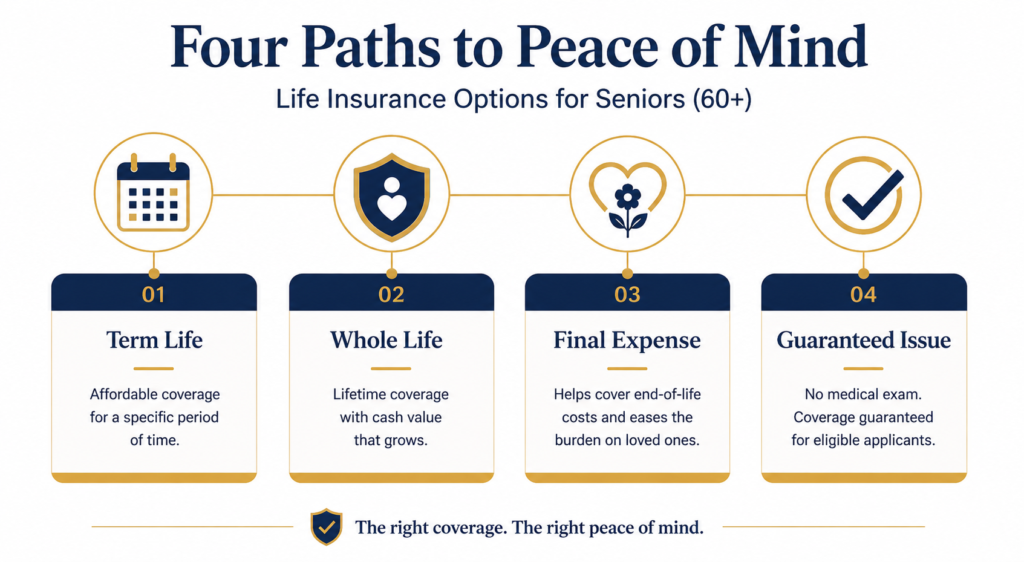
Term life insurance is usually the most affordable route for seniors still in reasonably good health, though availability narrows with age, some insurers stop offering new term policies past a certain application age (often around 75-80). Average monthly premiums for healthy 60-somethings start around $32 for women and $43 for men for a basic policy.
Whole life insurance provides permanent, lifelong coverage and builds cash value over time. It costs more than term, but the coverage never expires as long as premiums are paid, which matters if the goal is guaranteed payout rather than temporary protection.
Final expense insurance (also called burial insurance) is a smaller whole life policy, typically $5,000 to $25,000 in coverage, designed specifically to cover funeral costs, medical bills, and other end-of-life expenses rather than broader financial replacement.
Guaranteed issue life insurance requires no medical exam and no health questions at all. Approval is essentially automatic, which makes it the go-to option for seniors with significant health conditions who don’t qualify elsewhere, though coverage amounts are lower and premiums run higher per dollar of coverage than any other type.
What Life Insurance for Seniors Actually Costs Right Now
Real 2026 numbers vary a lot by age, health, and policy type, here’s what recent rate data across major carriers shows:
| Policy Type | Age 60 (Avg. Monthly) | Age 70 (Avg. Monthly) | Notes |
|---|---|---|---|
| Term life (healthy) | $32-$43 | Limited availability | Cheapest option if you qualify |
| Whole life | ~$229-$261 ($100K policy) | $600-$900+ | Rises sharply with age |
| Final expense/burial | $42-$55 ($10K policy) | $50-$70 | Smaller coverage, easier approval |
| Guaranteed issue | $72-$92 (women/men, $15K) | Higher | No exam, no health questions |
(Whole life costs can range from roughly $200/month at 55 to over $1,200/month by 80, depending on carrier, gender, and coverage amount. The gap between the cheapest and most expensive carrier at age 60 alone can run about $135 a month for identical coverage.)
No single company wins across every category, the same pattern I found comparing pet insurance for senior pets and car insurance for teenage drivers earlier, age drives pricing more than almost anything else across every insurance category.
Companies Worth Comparing for Life Insurance for Seniors (60+)
I looked at coverage limits, maximum issue age, and how each company handles no-exam options:
- State Farm: Rated a top overall pick for seniors, accepting applications up to age 90 depending on policy type, and offers guaranteed issue final expense coverage with no medical exam.
- USAA: Best overall for whole life among seniors if you qualify (military-affiliated), with the highest issue age and coverage up to $10 million, plus the lowest rates at 70 and older among providers reviewed.
- Gerber Life: Most affordable for seniors who buy before 65, a 60-year-old woman pays around $229/month for $100,000 in whole life coverage, though its guaranteed issue complaint index runs slightly higher than USAA’s.
- Mutual of Omaha: Rated best specifically for final expense policies, no-exam whole life available up to age 85, maximum death benefit of $25,000.
- AARP/New York Life: Offers discounted policies for AARP members, with guaranteed acceptance and fixed rates for life, though benefits are limited during the first two years of the policy.
- Penn Mutual: Lowest term life rates for women through their 60s in recent comparisons.
- John Hancock: Most affordable for men buying term coverage, accepts applicants up to age 80.
- Physicians Mutual: Most affordable guaranteed issue option for seniors with significant health conditions.
- Transamerica: Lowest final expense rates for policies up to $50,000 in coverage.
For a full breakdown across even more carriers, U.S. News’ best life insurance companies for seniors ranking and Forbes Advisor’s senior life insurance guide both go deeper into state-by-state availability than a single comparison can cover.
What If You Have Health Conditions?
This is exactly where my dad assumed he was out of luck, and he wasn’t. Many simplified and guaranteed issue plans specifically accept common conditions like diabetes, high blood pressure, and prior joint replacements, conditions that would have disqualified an applicant from traditional underwriting decades ago rarely do today. If you can’t qualify for a fully underwritten policy, guaranteed issue coverage exists specifically as a safety net, no health questions, no exam, acceptance essentially guaranteed, just at a higher price per dollar of coverage.
For real quotes based on specific health conditions rather than general estimates, MoneyGeek’s cheapest life insurance for seniors analysis compares thousands of quotes across 30 leading insurers by shopping profile, which is more useful than a single national average when health conditions are part of the picture.
Riders Worth Knowing About
A few optional add-ons are worth asking about specifically for senior policies:
- Accelerated death benefit rider: Lets you access part of your own death benefit early if you’re diagnosed with a terminal illness after purchasing the policy, useful for covering medical costs while you’re still alive rather than only after passing.
- Guaranteed purchase option: Allows increasing coverage later without new medical underwriting, useful if your needs might grow.
- Payment protection option: Can waive premiums under specific qualifying circumstances, worth checking the exact terms with your insurer.
Common Mistakes I’d Tell Any Senior or Their Family to Avoid
- Assuming health conditions disqualify you entirely. Guaranteed and simplified issue policies exist specifically for this, don’t rule yourself out without checking.
- Buying more coverage than actually needed. The monthly cost difference between a $100,000 and $250,000 policy adds up fast after 70, match the coverage to the actual goal (final expenses vs. debt vs. legacy).
- Waiting too long to shop. Rates climb steadily with age, and some insurers stop offering certain policy types past specific ages, the earlier you lock in a rate, the lower it stays for the life of the policy.
- Not comparing final expense against guaranteed issue. Both serve seniors with health concerns, but pricing and coverage caps differ meaningfully between them, get quotes for both before deciding.
- Ignoring the first-two-year benefit limitation on some guaranteed issue policies. A handful of guaranteed acceptance plans pay out a reduced amount if death occurs within the first two years from natural causes, worth confirming upfront.
- Not considering whether insurance still makes financial sense. If there are no dependents, no debt, and enough savings to cover final costs directly, premiums at 70 or 75 may provide less value than simply keeping that money accessible in savings instead.
Where This Leaves Us Now
My dad ended up with a final expense policy through one of the no-exam providers, approved within days, diabetes and knee replacement included without issue. It’s not the biggest policy in the world, but it covers exactly what my mother was worried about, and it cost far less than either of us expected walking into this.
If you or someone in your family has assumed life insurance for seniors isn’t realistically available past a certain age or health status, it’s worth the twenty minutes it takes to actually check, the same twenty minutes that turned my dad’s situation from a genuine worry into a solved problem. If you’re also working through other coverage decisions in the family, I’ve written about home insurance, health insurance, pet insurance for senior pets, and business insurance here on Insurance Pikr too.
For official guidance on policy types and consumer protections specific to senior life insurance, Ethos’ life insurance for seniors over 60 guide and CNBC Select’s best life insurance companies for seniors are both solid, current places to double-check numbers specific to your situation before deciding.
I write about this kind of practical, real-world insurance stuff regularly over on Insurance Pikr, so if this helped someone in your family the way it helped mine, there’s more where it came from.