
Cyber Insurance for Small Business: The Wire Transfer That Made Me Take This Seriously
An employee got an email that looked exactly like it came from me, same name, same tone, an urgent request to wire $18,000 to a “new vendor” before end of day. She sent it. It wasn’t until the real vendor called asking where their payment was that we realized what had actually happened. That $18,000 was gone, and our general liability policy, the one I’d assumed covered “business problems,” covered none of it.
That single email is exactly the kind of incident cyber insurance for small business exists to handle, and it’s exactly the kind of loss most small business owners assume can’t happen to them until it does. Here’s everything I actually learned afterward, what this coverage includes, what it costs in 2026, and whether your specific business genuinely needs it.
I’ve already covered general business coverage in my best business insurance guide, the freelancer angle in my business insurance for freelancers guide, and the liability distinction in my general liability vs professional liability guide here on Insurance Pikr. This one is specifically about cyber insurance for small business, since it’s become one of the fastest-growing, and most misunderstood, corners of business coverage in 2026.
Do Small Businesses Actually Need Cyber Insurance?
Yes, and the reasoning isn’t just theoretical anymore. Cybercriminals have increasingly shifted focus toward smaller organizations specifically because they tend to have limited security resources compared to large enterprises, making them easier targets for the same ransomware and business email compromise attacks that used to mostly hit big corporations. Total cyber claim payouts reached $7.8 billion in 2025 alone, and a meaningful share of that came from small and mid-sized businesses that assumed they were too small to be worth targeting.
General liability and property insurance policies, the ones most small businesses already carry, explicitly do not cover data breaches, ransomware, or network attacks. That gap is exactly what caught me off guard, and it’s why cyber insurance exists as an entirely separate policy rather than an add-on to what you probably already have.
What Cyber Insurance for Small Business Actually Covers
A solid policy typically includes both first-party and third-party protection. First-party coverage handles your own direct losses: ransomware negotiation and, in some cases, the ransom payment itself, IT costs to restore systems and data, and business interruption coverage if you’re unable to operate for days or weeks during recovery. Third-party coverage handles claims from others affected by a breach, client lawsuits, regulatory fines under laws like HIPAA or CCPA, and the notification and credit monitoring costs required when customer data is exposed.
Business email compromise coverage, the exact scenario that hit my business, has become one of the most commonly used parts of these policies in 2026, specifically covering losses from fraudulent wire transfers triggered by impersonation emails.
What Cyber Insurance for Small Business Actually Costs in 2026
| Business Profile | Typical Annual Premium | Coverage Limit |
|---|---|---|
| Small business, under $1M revenue | $1,200-$2,400 | $1 million |
| Standard small business (1-100 employees) | $1,500-$3,500 | $1 million |
| Mid-size business ($10M-$50M revenue) | $5,000-$15,000 | $1-2 million+ |
| Healthcare or financial services (regulated data) | $2,400-$20,000+ | $2 million+ |
| Monthly range across most small businesses | $37-$187/month | Varies by limit |
(Pricing depends heavily on industry, revenue, employee count, security controls already in place, and prior claims history. Businesses in cleaning services, transportation, and nonprofits tend to price 20%+ below average; healthcare, finance, and retail price meaningfully higher due to regulatory exposure.)
Cyber Insurance for Small Business Requirements You’ll Need to Meet
This is the part that’s changed the most heading into 2026. Insurers have tightened underwriting significantly, and a notable share of small businesses, over 73% by some industry estimates, fail their cyber insurance assessments on the first attempt, facing either denial or premium increases exceeding 300%. Reinsurers, the companies that insure the insurance companies, have pushed carriers to demand enterprise-level security standards even from small applicants.
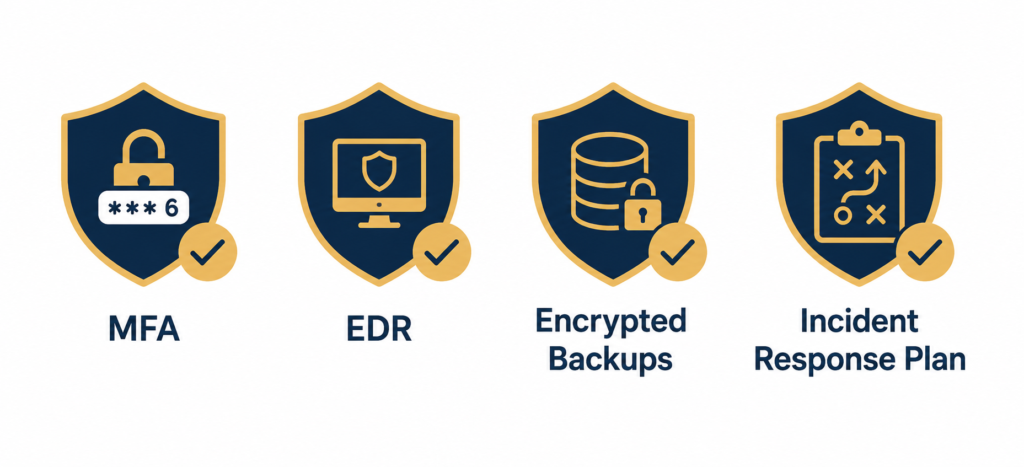
The baseline controls insurers now expect before issuing a policy typically include multi-factor authentication (MFA) across email and critical systems, endpoint detection and response (EDR) software, encrypted data backups, and a documented incident response plan. Skipping MFA or EDR alone can add 25-50% to your quote or disqualify you from coverage entirely, according to 2026 underwriting data. If you’re approaching a size threshold where you’ll be hiring your fifth or tenth employee, investing in these controls beforehand signals to insurers that you’re managing growth intentionally, which typically earns better rates than upgrading security only after you’ve already crossed that line.
Healthcare, finance, and retail businesses face stricter requirements specifically because of HIPAA and PCI-DSS regulations, often requiring coverage limits starting at $2 million rather than the standard $1 million baseline most small businesses carry.
How Much Coverage Does My Business Actually Need?
A reasonable starting benchmark is $1-2 million in coverage for most small businesses, though the right number depends on your specific revenue and data exposure. A commonly used formula is multiplying annual revenue by 2-5%, a $2 million revenue business would target roughly $40,000-$100,000 in minimum coverage, though many small businesses still opt for the standard $1 million limit as a baseline. It’s also worth checking your largest client contracts directly, many now specify required cyber coverage minimums that can exceed general industry benchmarks by 2-3 times, particularly if you handle their data or systems directly.
Common Mistakes Small Business Owners Make With Cyber Insurance
- Assuming general liability or a Business Owner’s Policy already covers this. It doesn’t, cyber incidents are explicitly excluded from standard liability and property coverage, requiring a genuinely separate policy.
- Waiting until after an incident to get coverage. Insurers won’t backdate a policy to cover a breach that already happened, and rates only get more expensive the longer you wait, especially as underwriting continues tightening.
- Skipping basic security controls before applying. Missing MFA or EDR can add 25-50% to your quote or result in outright denial, address these before shopping for a policy, not after getting quoted.
- Underestimating business email compromise risk. This is one of the most common claims in 2026, and it doesn’t require sophisticated hacking, just a convincing email and one employee acting on it.
- Not checking client contract requirements. Some contracts specify cyber coverage minimums well above what general industry benchmarks suggest, confirm this before assuming your standard policy is sufficient.
- Ignoring tail coverage when switching policies. If you switch insurers, a breach discovered after your old policy expires but tied to an earlier incident may not be covered without extended reporting (“tail”) coverage.
Where This Leaves Me Now
We recovered a portion of that $18,000 through the bank’s fraud department, but not all of it, and it’s exactly the gap cyber insurance for small business is designed to close going forward. I added a policy with BEC-specific coverage within a month, along with finally implementing MFA across every account that should have had it years earlier.
If you’ve been assuming your business is too small to be a target, or that your existing insurance already covers this, it’s worth the twenty minutes it takes to check before an email like the one my employee received lands in your own inbox. If you’re also working through other coverage decisions, I’ve written about life insurance, home insurance, health insurance, and pet insurance here on Insurance Pikr too.
For real-time quotes and requirement checklists by industry, MoneyGeek’s cyber insurance requirements guide and Christensen Group’s small business cyber insurance cost breakdown are both solid, current places to check numbers specific to your industry before you buy.
I write about this kind of practical, real-world insurance stuff regularly over on Insurance Pikr, so if this helped you catch a gap in your own coverage, there’s more where it came from.