
Homeowners Insurance Non-Renewal Crisis 2026: What Actually Happens
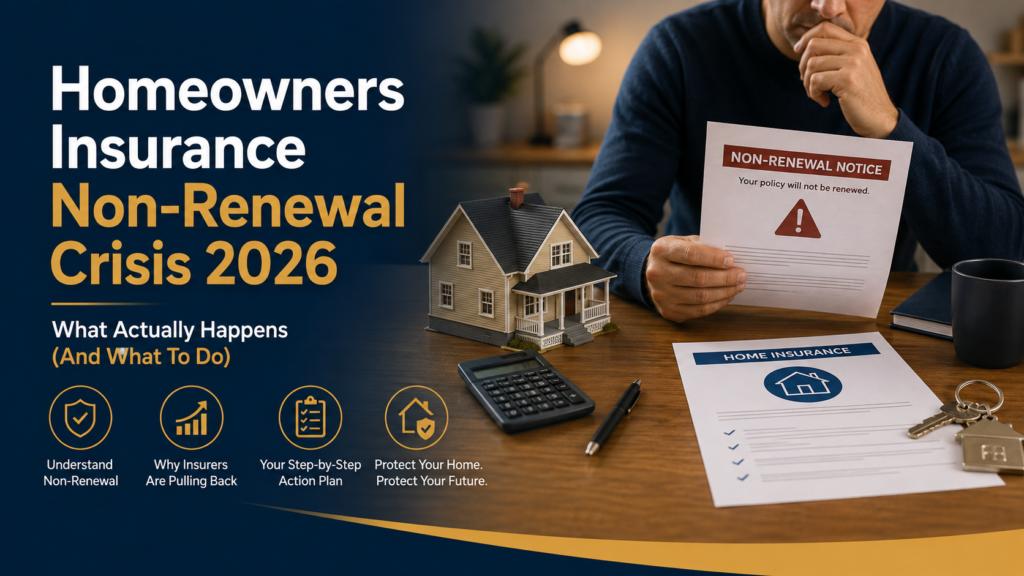
My neighbor Dave got a letter in April that made him call me at 9 p.m., half-panicked. His home insurer of eleven years, never missed a payment, never filed a big claim and had just sent him a non-renewal notice. No dramatic reason. Just a line buried in paragraph two: “we are no longer offering coverage in your area.”
He thought it was a mistake. It wasn’t and once I started digging into this for him, I realized this isn’t some isolated Florida-and-California problem anymore. It’s spreading and a lot of homeowners have no idea it’s coming until the letter shows up in their mailbox.
One of the first things I checked was his roof turns out that’s a bigger factor in these decisions than most people realize and I actually cover that in detail in how roof age affects your home insurance if you want to check whether that’s a risk factor for you too.
That’s basically the whole story behind the homeowners insurance non-renewal crisis in 2026. Let me walk you through what’s actually happening, why it’s happening and what I told Dave to do step by step, no fluff.
Wait, Isn’t This Just a California and Florida Thing?
That’s what I thought too, honestly. For years the headlines were all about wildfire zones in California or hurricane corridors in Florida. When I started pulling data for Dave’s case, the picture was bigger than that.
Insurers have been quietly pulling back in Georgia because of severe convective storms. The kind that spin up flash tornadoes with almost zero warning. Oklahoma, already known for sky-high premiums is now seeing carriers walk away too. Colorado and Louisiana have similar stories. This isn’t a coastal problem or a wildfire problem anymore, though wildfire zones are still where I see the worst of it. I’ve written a full breakdown of that in home insurance for wildfire areas if that’s more your situation. But overall, it’s becoming a nationwide underwriting problem.
Here’s the part that really stuck with me: researchers from NYU Stern and the University of British Columbia found that non-renewals aren’t just a homeowner inconvenience. They’re linked to higher foreclosure rates, dropping home values and weaker local spending in affected neighborhoods. That’s a much bigger deal than “my premium went up.”
Why Insurers Are Actually Doing This
I used to assume insurance companies just wanted more money. Turns out the reality is messier.
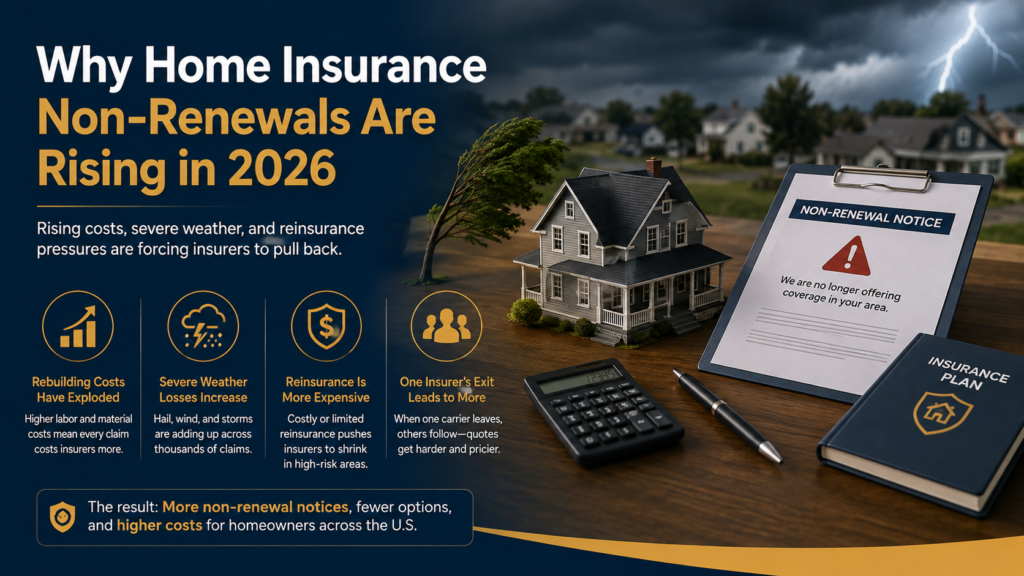
1. Rebuilding costs have exploded: Labor and construction material prices haven’t come back down after the last few years of inflation, So every claim now costs the insurer more to settle.
2. Severe weather losses keep piling up: Hail, wind, convective storms. These aren’t the “big scary hurricane” events but they add up fast across thousands of smaller claims.
3. Reinsurance is the hidden lever most people never hear about: Insurers buy their own insurance (called reinsurance) to protect themselves from catastrophic losses. When reinsurance gets expensive or hard to buy in a certain region, insurers respond by shrinking their book of business there meaning fewer new policies and more non-renewals.
4. One insurer’s exit predicts the next one’s decision: Carriers share loss data. If State Farm pulls out of your ZIP code don’t be shocked when your other quotes get weird too.
The FAIR Plan and Citizens Property Insurance: The Backup Nobody Wants
When private insurers won’t touch a property anymore, homeowners usually end up in a state-run “insurer of last resort.” In California this is the FAIR Plan. In Florida it’s Citizens Property Insurance.
I want to be upfront with you here – these plans are not a long-term fix. They’re meant to be a temporary safety net not a real homeowners policy replacement.
If you’re in California specifically, it’s worth knowing that even carriers still writing new business there can vary wildly on price. I was pulling comparisons for Dave and found MoneyGeek’s cheapest home insurance in California breakdown genuinely useful. It lays out average premiums by provider and by city which is a good sanity check before you assume the FAIR Plan is your only option.
Here’s the honest trade-off table I put together for Dave when he was weighing his options:
| Feature | Standard Private Policy | FAIR Plan / Citizens |
|---|---|---|
| Coverage scope | Full (fire, wind, theft, liability, etc.) | Often bare-bones, mainly fire |
| Liability coverage | Usually included | Frequently needs a separate add-on |
| Premium trend | Rising, but market-driven | Rising fast (FAIR Plan filed for a 35%+ hike recently) |
| Flood coverage | Not included (needs separate policy) | Not included either |
| Best used as | Primary coverage | Temporary bridge while shopping |
If you end up on a FAIR Plan or Citizens policy most agents will tell you to also buy a “difference in conditions” (DIC) policy to fill the coverage gaps. It’s an extra cost, but going without it means you’re seriously underinsured if something other than fire damages your home.
What I Told Dave To Actually Do (Step-By-Step)
This is the part that matters most, so let’s get practical.
Step 1: Don’t wait for the letter
If you’re in a high-risk ZIP code, call your agent now and just ask directly: “Is my carrier pulling back from this area?” Agents usually know before the official notice goes out.
Step 2: Read the non-renewal notice carefully
There’s almost always a reason listed high-risk classification, an old roof, claims history or the carrier simply exiting the state. That reason determines your next move.
Step 3: Start shopping immediately, not after your renewal date
Dave made the mistake of waiting three weeks “to think about it.” By the time he started getting quotes two of the four companies he tried weren’t even writing new policies in his county anymore. Don’t do what Dave did.
Step 4: Compare like-for-like coverage not just price
A cheaper quote that drops your liability limits or removes water damage coverage isn’t actually cheaper. It’s a gamble and if you’re currently renting out part of the property or considering it, the coverage rules change quite a bit. I broke that down in renters insurance vs homeowners insurance since people mix these up more than you’d think.
Step 5: Ask about mitigation credits
This one genuinely surprised me. Simple upgrades. A newer roof, storm shutters, water leak sensors, smart smoke detectors can knock a real percentage off your premium. Companies like State Farm, Nationwide, and Hippo all run programs where installing basic smart home devices (think Ring doorbells, water sensors or smart smoke alarms) can earn you a discount. It’s not huge but it adds up and it also genuinely reduces your risk of filing a claim in the first place.
Step 6: If you land on a FAIR Plan or Citizens, treat it as temporary
Set a calendar reminder every 6 months to re-shop the private market. Insurers do come back into markets once conditions stabilize and you don’t want to be stuck overpaying for bare-bones coverage longer than necessary.
Step 7: Appeal if you think the non-renewal is unfair
Some states allow appeals through the state Department of Insurance, especially if the decision seems to violate fair-practice rules. It’s not guaranteed to work but it costs nothing to try.
Mistakes I See Homeowners Make Constantly
- Assuming it can’t happen to them because they’ve never filed a claim: Dave hadn’t filed a claim in eleven years and still got dropped. It’s about area risk not just your personal history.
- Letting the policy lapse instead of actively switching: A gap in coverage even a few days can hurt you when applying for future insurance and leaves your home completely exposed.
- Only comparing premium price: I’ve seen people downgrade coverage so much to save $40 a month that they’d be devastated financially after a real claim.
- First-time buyers not budgeting for this at all: If you’re new to owning a home non-renewal risk isn’t something most people think to ask about before closing my guide on home insurance for first-time homebuyers covers what to check before you sign anything.
- Not checking if they even have flood coverage: Standard home insurance and FAIR plans both typically exclude flooding that requires a completely separate policy. If you’re unsure whether you need this. It’s worth reading up on it before assuming you’re covered.
- Ignoring the connection between roof age and non-renewal risk: Insurers are getting stricter about this and it’s honestly one of the most overlooked factors homeowners forget to check.
A Quick Reality Check on Where This Is Heading
I’m not going to pretend this gets easier next year. Reinsurance costs are trending down slightly which is good news long-term but the underlying wildfire, storm and rebuilding-cost pressures aren’t going anywhere.
One thing that’s actually helped a few people I know keep costs down during all this is bundling home and auto insurance. It won’t stop a non-renewal but it softens the financial hit when you do have to shop around. And if you’re starting completely from scratch on picking a new carrier, my rundown of the best home insurance policy in 2026 is a decent starting point before you commit to anything.
For an outside, unbiased look at how state insurance markets are shifting. The National Association of Insurance Commissioners (NAIC) publishes consumer-facing updates that are worth bookmarking. It’s one of the few sources that isn’t trying to sell you anything.
Final Thoughts
Dave ended up fine, for what it’s worth. He found a mid-sized regional carrier that was still actively writing policies in his county, added a water sensor kit that shaved a bit off the premium, and set a reminder to re-shop in six months. It wasn’t fun and it wasn’t cheap but it also wasn’t the disaster he thought it was going to be at 9 p.m. that night.
The homeowners who get through this non-renewal wave without a real crisis aren’t the lucky ones. They’re the ones who started paying attention before the letter showed up. If you own a home right now, especially anywhere near wildfire, storm or flood risk that’s basically your homework this month.