
Renters Insurance vs Homeowners Insurance: The Question My Landlord Forced Me to Actually Answer

My landlord emailed me two weeks before my lease renewal with one new line added to the contract: proof of renters insurance now required. I remember thinking, isn’t that basically the same thing as homeowners insurance, just for apartments? I genuinely didn’t know, and I’d been renting for six years at that point.
Turns out I wasn’t alone in that confusion. A lot of people conflate these two policies simply because they both have “insurance” and “home” in the same sentence somewhere, but they cover fundamentally different things, cost wildly different amounts, and serve completely different situations. Here’s everything I actually learned working through renters insurance vs homeowners insurance, once I had an actual deadline forcing me to figure it out.
I’ve already covered general home insurance strategy in my best home insurance policy guide and the first-time buyer angle in my home insurance for first-time homebuyers guide here on Insurance Pikr. This one is specifically about the renters vs homeowners distinction, what each actually covers, and where people genuinely trip up.
Table of Contents
- The Real Difference Between Renters Insurance vs Homeowners Insurance
- What Renters Insurance vs Homeowners Insurance Actually Costs
- What Each Policy Actually Covers
- Why Homeowners Insurance Costs So Much More
- When You Actually Need Each One
- Common Mistakes I’d Tell Anyone to Avoid
- Where This Leaves Me Now
The Real Difference Between Renters Insurance vs Homeowners Insurance
The core distinction comes down to one thing: dwelling coverage, protection for the actual physical structure of the building. Homeowners insurance (technically called an HO3 policy) includes it, since you own the structure and are financially responsible for rebuilding it after damage. Renters insurance (an HO4 policy) does not, and doesn’t need to, because your landlord’s own insurance covers the building itself.
Beyond that one difference, the two policies are structurally similar. Both typically include personal property coverage (your belongings), liability protection (if someone’s injured on your property or you accidentally damage someone else’s), and additional living expenses, sometimes called loss of use, which pays for a hotel or temporary housing if your home becomes unlivable after a covered event like a fire.
What Renters Insurance vs Homeowners Insurance Actually Costs
This is where the gap becomes obvious, and it’s a big one:
| Policy Type | Avg. Monthly Cost | Avg. Annual Cost |
|---|---|---|
| Renters insurance | $19-$23 | $173-$276 |
| Homeowners insurance | $179-$217 | $2,377-$2,601 |
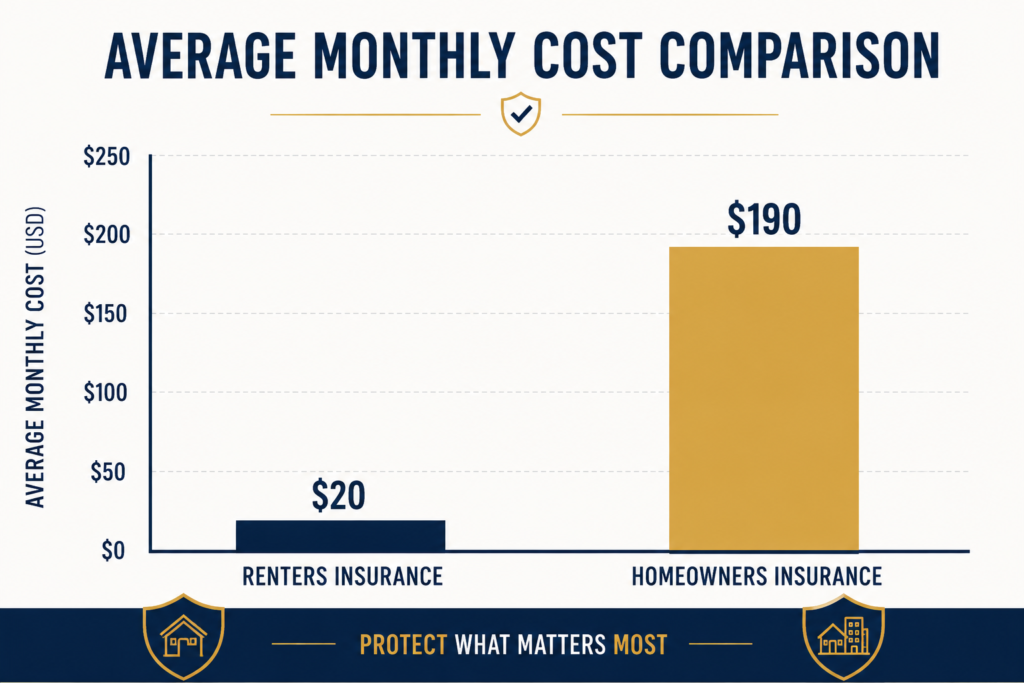
Renters insurance costs a fraction of homeowners insurance simply because it’s insuring far less, your belongings and your liability, not an entire structure that could cost hundreds of thousands of dollars to rebuild. According to Insurance.com’s 2026 cost comparison, the average homeowners policy runs close to ten times the cost of a renters policy nationally, and that gap holds fairly consistent across most states.
What Each Policy Actually Covers
Homeowners insurance typically includes five core coverages: dwelling (the structure itself), other structures (detached garages, sheds, fences), personal property, personal liability, and additional living expenses. It’s built around the assumption that you’re financially responsible for the entire property, not just what’s inside it.
Renters insurance includes everything homeowners insurance does except dwelling and other structures coverage, since those aren’t your responsibility as a tenant. Renters typically choose $25,000 to $40,000 in personal property coverage and around $100,000 in liability coverage, a combination that balances reasonable protection with an affordable premium.
Both policies generally exclude flood and earthquake damage by default, regardless of whether you rent or own, that coverage has to be added separately in both cases, usually through the National Flood Insurance Program or a private flood insurer, something I’ve also covered in more detail in my home insurance guide.
Why Homeowners Insurance Costs So Much More
The math here is straightforward once you see it laid out: dwelling coverage represents the single largest portion of a homeowners premium, because rebuilding an entire structure after a total loss can run into the hundreds of thousands of dollars. Renters insurance skips this entirely, your landlord already insures the building through their own policy, which is exactly why a renter’s premium stays so much lower even though the liability and personal property portions of both policies are structurally similar.
Location, home age, construction type, and claims history all affect homeowners premiums meaningfully more than they affect renters premiums, since a bigger, more expensive-to-rebuild structure carries more variables that can drive cost up or down.
When You Actually Need Each One
If you’re renting an apartment, condo, or house, renters insurance protects your belongings and liability at a genuinely low monthly cost, and increasingly, landlords require it before signing or renewing a lease, exactly the situation that got me looking into this in the first place.
If you own your home outright or have a mortgage, homeowners insurance isn’t really optional, mortgage lenders require proof of an active HO3 policy before closing, and continued coverage for as long as the loan exists. I’ve written more about that specific transition, and the timeline pressure that comes with it, in my first-time homebuyer insurance guide.
One thing worth knowing if you’re transitioning from renting to owning: you don’t keep your renters policy and simply upgrade it, you need an entirely new HO3 policy in place before your closing date, since the coverage type itself changes, not just the limits.
If you own a property you rent out to someone else, neither of these policies is actually right for you, that situation calls for landlord insurance instead, which covers the building plus liability specific to having tenants, but generally doesn’t cover a tenant’s own belongings.
Common Mistakes I’d Tell Anyone to Avoid
- Assuming your landlord’s insurance covers your belongings. It doesn’t, their policy covers the building structure, not anything inside your unit that belongs to you.
- Skipping renters insurance because it feels unnecessary. At $19-$23 a month on average, it’s one of the most affordable policies available, and covers real scenarios like theft, fire, or a guest injury lawsuit.
- Confusing actual cash value with replacement cost coverage. Actual cash value factors in depreciation on damaged items, replacement cost pays what it actually costs to replace them new, this distinction matters in both renters and homeowners policies.
- Not increasing coverage after a major purchase. New electronics, jewelry, or furniture can push you past your existing personal property limit without you realizing it.
- Assuming homeowners insurance covers flood damage. It doesn’t, under either policy type, that’s always a separate policy.
- Waiting until moving day to buy either policy. Both take only minutes to set up online, but lenders and landlords alike often require proof before you’re allowed to move in or close.
Where This Leaves Me Now
I ended up getting a renters policy within a day of that email, $17 a month for coverage that would have taken care of a genuinely bad situation if my apartment had ever flooded or burned. It’s one of those costs that feels unnecessary right up until the one time it isn’t, which is really the entire point of insurance in the first place.
If you’re currently renting without a policy, or you’re a first-time buyer trying to understand why your new insurance costs so much more than your old one did, hopefully this cleared up exactly where that gap comes from. If you’re also working through other coverage decisions, I’ve written about life insurance, health insurance, car insurance, and pet insurance here on Insurance Pikr too.
For deeper state-by-state cost breakdowns, MoneyGeek’s renters vs homeowners insurance comparison and ValuePenguin’s full coverage comparison are both solid, current places to check numbers specific to your situation before you buy either policy.
I write about this kind of practical, real-world insurance stuff regularly over on Insurance Pikr, so if this helped clear things up, there’s more where it came from.