
Home Insurance for First-Time Homebuyers in 2026: What Nobody Told Me Before My Closing Date

Three days before closing on my first house, my lender emailed asking for proof of homeowners insurance. I remember staring at that email genuinely confused, I hadn’t even moved in yet, the house wasn’t technically mine, and somehow I already needed an active insurance policy just to finish buying it.
Nobody walks you through this part. Everyone talks about mortgage rates, down payments, and closing costs, but home insurance gets mentioned almost as an afterthought, right up until it becomes an urgent, non-negotiable requirement with a deadline attached. I scrambled, got a policy two days before closing, and later realized I’d overpaid and under-covered myself because I didn’t understand what I was actually buying.
This isn’t a “what is homeowners insurance” article. This is specifically what I wish someone had told me as a first-time buyer, the timeline, the actual costs, the discounts almost nobody mentions, and the mistakes that cost me money in year one. I’ve already covered general home insurance strategy in my best home insurance policy guide here on Insurance Pikr, this one is specifically about home insurance for first-time homebuyers going through this exact process for the first time.
Table of Contents
- Why Your Lender Requires Home Insurance for First-Time Homebuyers Before Closing
- How Much Does Home Insurance for First-Time Homebuyers Actually Cost?
- The Mistake I Made: Confusing PMI With Homeowners Insurance
- Getting Dwelling Coverage Right
- Discounts First-Time Buyers Often Don’t Know to Ask About
- Step-by-Step: How I’d Actually Do This the Second Time Around
- What About Flood and Wildfire Risk?
- Common Mistakes I’d Tell Any First-Time Buyer to Avoid
- Where This Leaves Me Now
Why Your Lender Requires Home Insurance for First-Time Homebuyers Before Closing
Here’s the part that confused me most: your mortgage lender requires proof of home insurance for first-time homebuyers before closing because the house is collateral for their loan. If it burned down the week after closing with no insurance in place, the lender’s entire investment would be at risk, not just yours. That’s why you need an active policy starting on your closing date, not sometime after you move in.
Most lenders want your policy to name them as an “additional interest” or “mortgagee,” and going forward, your annual premium usually gets rolled into your monthly mortgage payment through an escrow account rather than billed to you separately. Nobody explained this to me either, I kept waiting for a separate insurance bill that was never coming because my lender was already collecting it monthly and paying the insurer directly once a year.
How Much Does Home Insurance for First-Time Homebuyers Actually Cost?
As of 2026, the average home insurance for first-time homebuyers costs somewhere around $2,424 a year, or roughly $202 a month, for a policy with $300,000 to $400,000 in dwelling coverage. That’s a national average though, and it swings widely, in some high-risk states it can run $500 or more a month, while lower-risk states can come in well below the national average.
Rates have been climbing for a few consecutive years now, driven mostly by rebuilding costs (materials and labor both up) and increasingly frequent severe weather events, wildfires in the West, hail across the Midwest, hurricanes through the Southeast. According to NerdWallet’s 2026 homeowners insurance cost analysis, roughly a third of homeowners saw their premium increase in just the past year, even without filing any claims.
None of that is something you personally caused or can undo, but understanding it helps explain why the quote you get might feel higher than you expected walking in.
The Mistake I Made: Confusing PMI With Homeowners Insurance
If you put down less than 20%, which most first-time buyers do, you’re probably also paying private mortgage insurance (PMI), and I genuinely thought this was the same thing as my homeowners policy for embarrassingly long. It’s not.
- PMI protects your lender if you default on the loan. It typically costs 0.5% to 1.5% of your total mortgage annually and disappears once you hit 20% equity.
- Homeowners insurance protects your actual home and belongings from damage, theft, and liability, and it never goes away as long as you own the home (or have a mortgage requiring it).
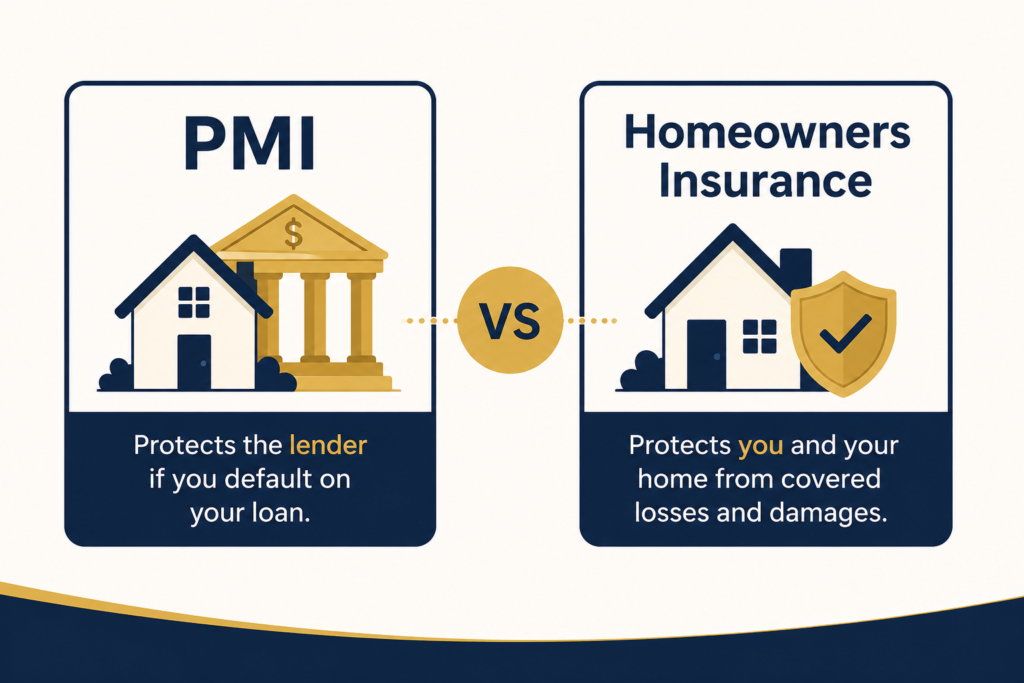
They’re billed separately, serve completely different purposes, and confusing them, like I did, means you might not realize you’re paying for both, or budget incorrectly assuming one covers what the other actually does.
Getting Dwelling Coverage Right (This Is the Number That Matters Most)
The single biggest mistake first-time buyers make is setting their dwelling coverage based on either their purchase price or their home’s market value. Neither of those is the right number.
Dwelling coverage should reflect the actual rebuild cost, what it would cost today to reconstruct your home from the ground up: materials, labor, permits, all of it. A $400,000 home in a hot market might only cost $280,000 to actually rebuild, or the reverse could be true in a high-labor-cost area. Being underinsured here is where a claim can turn into a real financial problem even though you technically have a policy.
Most insurers calculate this for you during the quote process using a rebuilding cost estimator, but it’s worth double-checking against a contractor’s rough estimate if your home has any unusual features (custom finishes, additions, older construction methods that are more expensive to replicate today).
Discounts First-Time Buyers Often Don’t Know to Ask About
This part genuinely surprised me while shopping for home insurance for first-time homebuyers. A handful of major insurers offer new homebuyer discounts specifically for people who just bought their first house, and almost nobody mentions this upfront:
- Allstate offers a new homebuyer discount for those who recently purchased
- Nationwide has a home purchase discount for buyers within the last 12 months
- Progressive offers a new purchase discount, including for people switching over from a renters insurance policy
- Travelers has a homebuyer discount for recent purchasers
- Farmers offers a rent-to-own discount specifically for renters insurance policyholders transitioning to a homeowners policy
Worth noting: some “new home” discounts are actually for newly built homes rather than newly purchased ones, so ask specifically which type applies before assuming you qualify. U.S. News’ guide for first-time buyers breaks this distinction down clearly if you want to verify before you shop.
Beyond first-time-buyer-specific discounts, the standard levers still apply and stack on top: bundling home and auto with the same insurer, raising your deductible, smoke-free home discounts, and security system discounts. Raising your deductible from $1,000 to $2,500, for example, lowers your average rate by roughly 9%, according to NerdWallet’s rate analysis, a meaningful save if you have the emergency savings to cover that higher out-of-pocket amount if you ever needed to file a claim.
Step-by-Step: How I’d Actually Do This the Second Time Around
1. Start shopping the moment you’re under contract, not the week of closing. You typically have 30-45 days between accepted offer and closing. Use that window, don’t wait until three days before like I did, since rushing means less time to actually compare options.
2. Get quotes from at least 3-4 companies with identical coverage limits. Comparing a $250,000 dwelling limit quote against a $320,000 quote tells you nothing useful. Match the numbers first, then compare price.
3. Ask directly about first-time buyer and bundling discounts. These aren’t always advertised on the quote page itself, ask the agent or check the fine print directly.
4. Confirm your dwelling coverage reflects rebuild cost, not purchase price. This is worth a five-minute conversation with your agent before you sign anything.
5. Check your credit before shopping, if your state allows credit-based pricing. Credit affects your homeowners insurance rate in 44 states, and the gap between excellent and poor credit can be substantial depending on the insurer. California, Hawaii, Michigan, and Massachusetts are among the states that prohibit this practice entirely, so it matters where you live.
6. Send your lender the declarations page as soon as you bind the policy. Your lender needs proof of coverage before closing, and delays here can genuinely hold up your closing date. Don’t wait for them to ask twice.
7. Re-shop at your first renewal, not just at purchase. About 1 in 5 homeowners shop around for a new insurer every year, according to a 2026 NerdWallet survey, and it’s consistently the most effective way to catch a better rate as your circumstances (and the market) change.
What About Flood and Wildfire Risk?
Standard homeowners insurance does not cover flood damage under any circumstances, this is a separate policy entirely, usually through the National Flood Insurance Program or a private flood insurer. If you’re buying in a flood zone, your lender will likely require this separately regardless of what your homeowners policy includes.
Wildfire coverage is typically included in standard policies, but in high-risk wildfire zones, some insurers have pulled back entirely or added significant surcharges. If you’re buying in a wildfire-prone area (parts of California, the Pacific Northwest, and increasingly parts of the Mountain West), it’s worth confirming availability and pricing before you’re locked into a purchase contract, not after.
Common Mistakes I’d Tell Any First-Time Buyer to Avoid
- Waiting until the week of closing to start shopping. This is exactly what I did, and it meant less time to compare and a rushed decision under pressure.
- Confusing PMI with homeowners insurance. They’re separate costs serving completely different purposes, and assuming otherwise can mess up your monthly budget.
- Setting dwelling coverage based on purchase price instead of rebuild cost. These numbers are often very different, and this is the single biggest coverage gap first-time buyers create for themselves.
- Not asking about first-time buyer discounts. These genuinely aren’t always advertised upfront, you often have to ask directly.
- Assuming your homeowners policy covers flood damage. It doesn’t, ever, under a standard policy.
- Forgetting to update coverage after move-in renovations. If you finish a basement or add a room in year one, your dwelling coverage needs to reflect that change.
Where This Leaves Me Now
I’ve since switched insurers twice, gotten my dwelling coverage number actually right, and picked up discounts I didn’t know existed the first time around. The three-day scramble before my first closing turned into a genuinely useful crash course, just one I’d rather have taken with more breathing room.
If you’re currently under contract on your first home, start shopping for home insurance for first-time homebuyers now rather than waiting for your lender’s reminder email. And if you’re also working through other coverage decisions around this same life stage, I’ve written about my own experience with life insurance, health insurance, car insurance, business insurance, and pet insurance here on Insurance Pikr too.
For real cost breakdowns and rate comparisons across states, Bankrate’s first-time homebuyer insurance guide is a solid, unbiased place to check numbers specific to your situation before you commit to a policy.
I write about this kind of practical, real-world insurance stuff regularly over on Insurance Pikr, so if this helped, there’s more where it came from.