

Best Business Insurance in the USA for 2026: How to Choose the Right Coverage

You’ve done the hard parts. You picked a name. You found your first customers. Maybe you signed a lease or bought equipment. Then a landlord or a client asks for your certificate of insurance and you realize you’re not sure what you even need.
Searching for the best business insurance in the USA doesn’t help much either. Every company claims to be the best. The truth is simpler and a little less exciting. The best business insurance is the set of policies that matches your actual risks at a price you can keep paying. This guide shows you how to figure that out.
The quick answer
Most small businesses start with general liability. Many add commercial property and bundle the two into a business owner’s policy. If you give advice or professional services you’ll likely need professional liability. If you have employees most states require workers’ comp. Businesses with vehicles need commercial auto. And businesses that handle customer data should look at cyber insurance.
The core policies at a glance
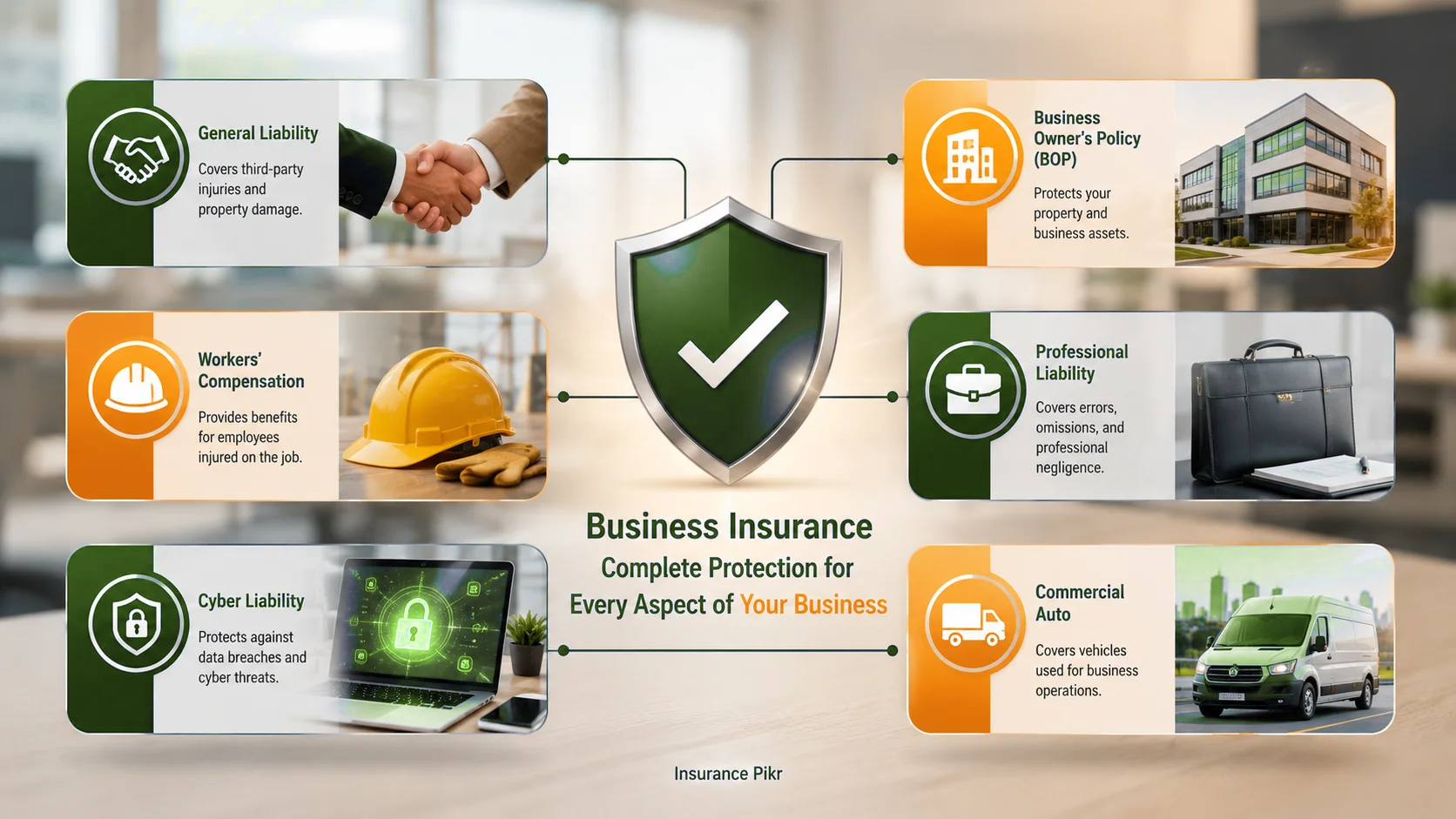
| Policy | What it covers | Who usually needs it |
|---|---|---|
| General liability | Injuries to others and damage to their property and some advertising claims | Almost every business |
| Commercial property | Your building and equipment and inventory | Businesses with a location or valuable gear |
| Business owner’s policy | General liability and property bundled together often with business interruption | Many small businesses with low to moderate risk |
| Professional liability | Mistakes in your work or advice | Consultants and designers and tech and service pros |
| Workers’ compensation | Employee injuries and illnesses from work | Businesses with employees in most states |
| Commercial auto | Vehicles used for business | Businesses that own or regularly drive vehicles for work |
| Cyber insurance | Data breaches and ransomware and some fraud | Businesses that store customer data or take payments online |
Start with your real risks
Here’s the simplest way I know to work out what you need. Grab a piece of paper and answer five questions.
- Do customers or clients visit you or do you visit them
- Do you give advice or create work that clients rely on
- Do you have employees even part time
- Do you own a location or equipment or inventory
- Do you store customer data or take payments online
Every yes points to a policy. Visits point to general liability. Advice points to professional liability. Employees point to workers’ comp. Property points to commercial property. Data points to cyber.
Why a business owner’s policy is often the best starting point
A business owner’s policy or BOP bundles general liability with commercial property. Many also include business interruption coverage. That pays some lost income if a covered event like a fire forces you to close for a while.
For many small shops and offices a BOP costs less than buying each piece on its own. But not every business qualifies. High-risk industries may need separate policies. And a BOP usually doesn’t include professional liability or workers’ comp or commercial auto.
How to judge an insurer
The company behind the policy matters as much as the price. Here’s what I’d check before buying.
Financial strength. Ratings from agencies like AM Best show whether an insurer is likely to be able to pay claims. A strong rating is a good sign.
Complaint record. The NAIC’s Consumer Insurance Search shows complaint data for insurers in your state.
Experience with your industry. A company that insures lots of businesses like yours usually understands your risks better.
Ease of service. Can you get a certificate of insurance quickly? Can you reach a real person when you need to file a claim?
Insurers that often appear in small business comparisons
These names come up again and again in consumer and industry comparisons. This isn’t an endorsement. The right fit depends on your industry and state and size.
- The Hartford and Travelers and Nationwide are large carriers with long histories in small business coverage
- Hiscox and NEXT Insurance are known for fast online quotes for small and home-based businesses
- Chubb often appears for businesses with higher-value property or more complex needs
- State Farm and Farmers sell business coverage through local agents
An independent agent can quote several of these at once. That can save you a lot of time.

How to buy business insurance step by step
Step 1: Answer the five risk questions above and list the policies they point to.
Step 2: Check any contracts and your lease for required policies and limits.
Step 3: Check your state’s rules for workers’ comp and commercial auto.
Step 4: Get at least three quotes. Try an independent agent and one online insurer and one company that specializes in your industry.
Step 5: Compare limits and deductibles and exclusions and not just price.
Step 6: Save your certificates of insurance in one folder you can share quickly.
Step 7: Review coverage every year or when you add employees or move or buy new equipment.
What affects the price
- Your industry and how risky the work is
- Your location and the state you operate in
- Your revenue and payroll and number of employees
- Your claims history
- The limits and deductibles you pick
- The value of your property and equipment
Ways to lower your premium without losing protection
Business insurance is a real expense. But there are smart ways to bring it down that don’t leave you exposed.
- Bundle policies with one insurer when it makes sense
- Choose a higher deductible only if you can pay it from savings
- Pay the full year up front if your insurer offers a discount for it
- Put simple safety rules in writing and train your team on them
- Install alarms and cameras and fire protection where you work
- Keep your claims small by fixing hazards quickly
- Review your payroll and revenue estimates so you aren’t overcharged
Also keep good records. When an insurer sees clean paperwork and a clear safety plan, you often look like a better risk. That can help at renewal time.
When to talk to an agent and not just buy online
Buying online is fast and works well for many simple businesses. But some situations really benefit from a human who knows the market.
Talk to an agent if you work in a higher-risk field like construction or food service. Do the same if you have several employees or vehicles or if a big client contract has detailed insurance language. An experienced agent can spot gaps and explain wording that’s easy to miss on a quote screen.
A hypothetical example
Picture a small coffee shop with five part-time employees. The owner buys a BOP to cover customer slips and her espresso machines and lost income if a kitchen fire forces a closure. She adds workers’ comp because her state requires it. She takes card payments so she adds a small cyber policy too.
Now picture a solo marketing consultant who works from home. A BOP might be overkill. Professional liability plus a home business endorsement could fit better.
These are only illustrations. But they show how different two small businesses can be.
Common mistakes when buying the best business insurance
- Skipping workers’ comp when your state requires it
- Buying on price alone without reading limits and exclusions
- Assuming a BOP covers everything
- Using personal car insurance for regular business driving
- Forgetting to update coverage as the business grows
- Ignoring cyber risk because you think you’re too small
Frequently asked questions
What business insurance is legally required?
It depends on your state and setup. Workers’ comp is required in most states once you have employees. Commercial auto is required for business-owned vehicles. Some licensed professions require other coverage.
Is a business owner’s policy worth it?
For many small businesses with a location or equipment it’s a good value. Compare it with separate policies to be sure.
How much business insurance do I need?
Start with what your contracts and lease require. Then think about your worst realistic claim and choose limits that would cover it.
A calm way to finish
The best business insurance isn’t one company or one policy. It’s a plan that matches what could really go wrong in your business. Start with your risks. Compare a few quotes. And check in on your coverage as you grow.
For deeper dives see our guides on general liability vs professional liability insurance and workers’ compensation for small business. The US Small Business Administration also has a plain overview.
Disclaimer: This article is general information and not legal or insurance advice. Requirements and prices vary by state and industry. Talk to a licensed insurance professional before you buy coverage.