

General Liability vs Professional Liability Insurance: Which Do You Need?

You land a new client. They send over a contract and somewhere on page four it says you must carry general liability and professional liability insurance. You nod like you know the difference. Then you close the laptop and quietly search what those words actually mean.
That’s completely normal. These two policies sound alike but they protect against very different problems. This guide explains general liability vs professional liability insurance in plain English. You’ll see what each covers and who needs which. You’ll also learn how to avoid paying for the wrong one.
The quick answer
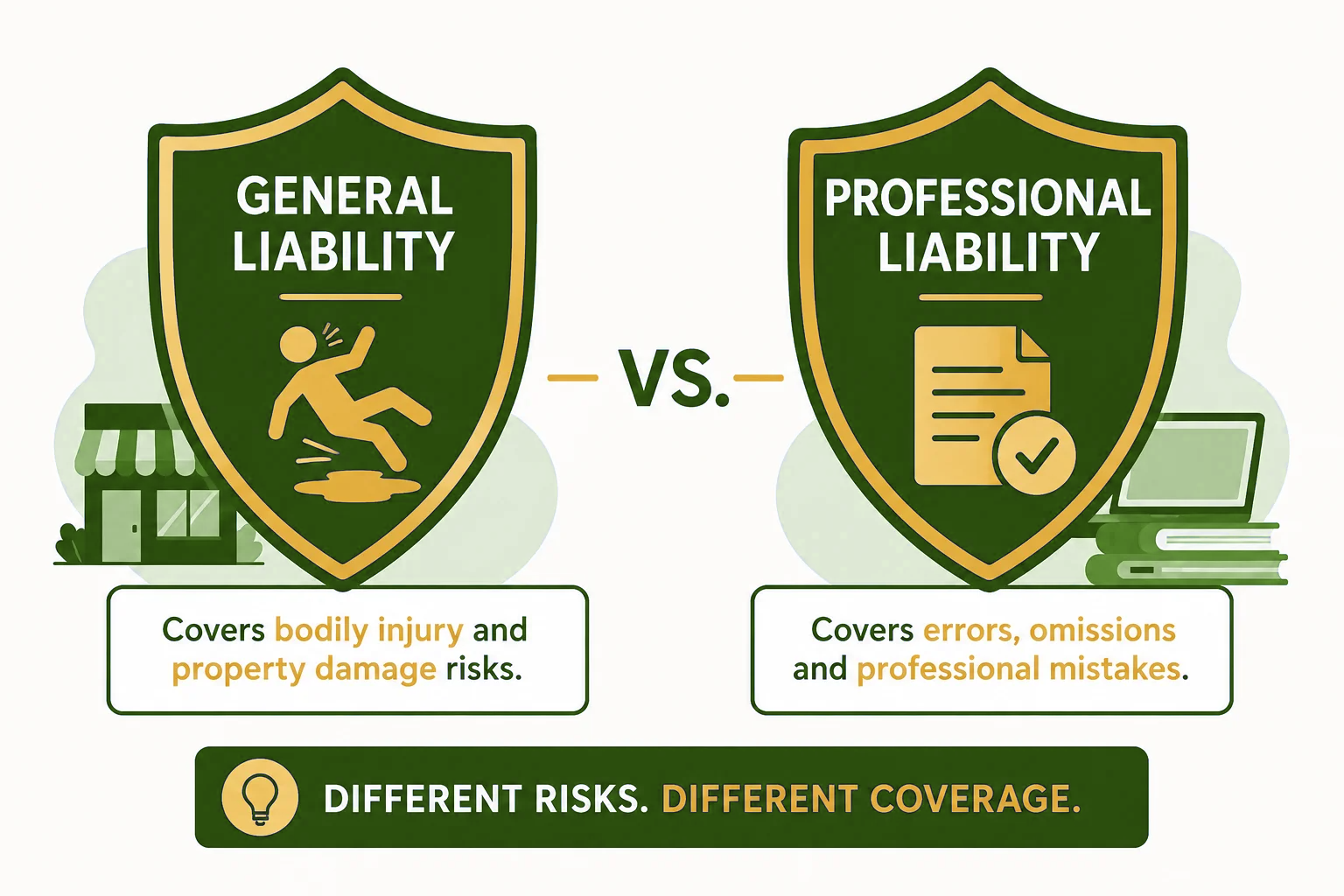
General liability covers physical problems. Think injuries to other people and damage to their property and some advertising claims. Professional liability covers mistakes in your work or advice that cost a client money. A contractor who breaks a client’s window needs general liability. A consultant whose bad advice loses a client money needs professional liability. Many businesses need both.
General liability in plain words
General liability is sometimes called GL or commercial general liability. It covers claims from people outside your business who say you caused them physical harm or damaged their stuff.
- A customer slips on a wet floor in your shop
- You knock over and break a client’s expensive lamp during a home visit
- Your product causes an injury
- A competitor says your ad copied their slogan
- Someone claims you damaged their reputation with a false statement
Landlords often require it before they’ll sign a lease. Many clients ask for it too.
Professional liability in plain words
Professional liability is also called errors and omissions or E&O. Doctors call their version malpractice insurance. It covers claims that your professional work or advice was wrong or late or incomplete and that it cost someone money.
- A web designer misses a launch date and the client loses sales
- An accountant makes a tax error that leads to penalties
- A marketing consultant gives advice that backfires
- A real estate agent leaves out an important detail in paperwork
- An IT contractor’s mistake causes a client’s system outage
Even if you did nothing wrong, defending a lawsuit is expensive. Professional liability usually helps pay legal defense costs too.
Side by side comparison
| Question | General liability | Professional liability |
|---|---|---|
| Main risk | Physical injury and property damage | Financial loss from your work or advice |
| Typical claim | A visitor trips and gets hurt | A client says your mistake cost them money |
| Who usually needs it | Shops and contractors and anyone who meets clients in person | Consultants and designers and advisers and tech pros |
| Who often requires it | Landlords and clients and event venues | Clients and some licensing boards |
| Policy trigger | Usually occurrence based | Usually claims made |
The claims-made detail that trips people up
This one is a little technical but it matters. Honestly it’s the part most owners never hear about until it’s too late.
General liability is usually occurrence based. That means the policy that was active when the incident happened responds, even if the claim comes years later.
Professional liability is usually claims made. That means the policy must be active both when the work happened and when the claim is filed. If you cancel your E&O policy and a client sues you next year about old work, you may have no coverage.
Two terms help here. A retroactive date is the earliest date of work your policy will cover. Tail coverage is an add-on that extends your right to report claims after a policy ends. If you’re retiring or closing a business ask your agent about tail coverage.
Who needs which
Mostly general liability. Retail shops and restaurants and contractors and landscapers and cleaning services. Their biggest risk is someone getting hurt or something getting broken.
Mostly professional liability. Consultants and accountants and bookkeepers and software developers and marketers and designers. Their biggest risk is a client losing money because of their work.
Both. Plenty of businesses fall in the middle. An IT pro who visits client offices can damage equipment and also make a costly configuration error. A personal trainer can cause an injury and also be accused of giving bad guidance.
How a business owner’s policy fits in
A business owner’s policy or BOP bundles general liability with commercial property coverage. It’s often a good deal for small businesses with a physical location or equipment. But a BOP usually doesn’t include professional liability. You’ll typically buy that separately or as an add-on.
How much coverage is enough
Policies usually show two numbers. The per-claim limit is the most the policy pays for one claim. The aggregate limit is the most it pays for all claims in the policy year. You’ll often see a pair like $1 million per claim and $2 million aggregate.
Many client contracts ask for exactly that. But don’t just copy the contract number without thinking. Ask yourself how big a mistake could get in your line of work. A consultant advising on a large project could face a much bigger claim than a dog walker. A higher limit costs more but often not as much more as people expect.
Also check the deductible. That’s the amount you pay before the policy kicks in. Some professional liability policies also count legal defense costs against your limit. That means a long lawsuit can eat into the money left for a settlement.
What affects the price
- Your industry and the type of work you do
- Your yearly revenue and number of employees
- Your claims history
- The limits and deductible you choose
- Where your business operates
- Your experience and any professional licenses
A home-based bookkeeper and a construction contractor will see very different prices even with the same limits. That’s because the kinds of claims they face are so different. Getting quotes from a few insurers is the only reliable way to know your real cost.
How to choose step by step
Step 1: Write down the worst things that could realistically happen in your business. Separate physical accidents from work mistakes.
Step 2: Read your client contracts and your lease. Note any insurance requirements and minimum limits.
Step 3: Get quotes for each policy and for a combined package if available.
Step 4: For professional liability, check the retroactive date and whether defense costs reduce your limit.
Step 5: Ask for a certificate of insurance once you buy. Clients often want to see it before work starts.
A hypothetical example
Picture a freelance web developer. While setting up a client’s office network she trips over a cable and knocks a monitor to the floor. That’s a general liability claim. A month later the site she built goes down on launch day because of a coding error and the client loses a weekend of sales. That’s a professional liability claim.
Same person. Same client. Two completely different policies. This is only an illustration but it shows why many people need both.
Common mistakes with general liability vs professional liability insurance
- Assuming general liability covers mistakes in your work
- Canceling E&O without thinking about past work
- Ignoring the retroactive date on a new policy
- Buying limits lower than your client contracts require
- Thinking a BOP includes professional liability
- Waiting until a client asks for a certificate to buy coverage
Frequently asked questions
Is professional liability the same as E&O?
Yes. Errors and omissions is another name for professional liability. Medical professionals call it malpractice insurance.
Do freelancers need general liability?
If you meet clients in person or work at their location it’s often a good idea. Many clients require it in contracts.
Can I buy both in one policy?
Some insurers offer packages for specific industries. Compare the limits for each part before you buy.
A calm way to finish
The easiest way to remember the difference is this. General liability is about bodies and property. Professional liability is about advice and work product. Look at your real risks and your contracts. Then buy the coverage that matches how your business actually operates.
If you’re a freelancer or run a side hustle our guide to business insurance for freelancers goes deeper. Using AI tools at work? Read our article on AI liability insurance for small business. The US Small Business Administration also has a helpful overview of common business policies.
Disclaimer: This article is general information and not legal or insurance advice. Policy wording and limits vary by insurer and state. Talk to a licensed insurance professional before you buy coverage.