
Multi-Pet Insurance Discounts: What I Learned Adding a Second Dog to My Policy

Bringing home a second dog felt like doubling my vet bills overnight, and I genuinely assumed insuring her would just mean paying my existing premium twice. Then I called my insurer to add her to my account and found out something I hadn’t thought to ask about: multi-pet insurance discounts, a detail buried in the fine print that ended up saving me more than I expected once I actually understood how it worked.
If you’re staring down the cost of insuring more than one animal, this is everything I actually learned comparing providers, understanding how the discount is calculated, and where the real savings, and the real gotchas, actually are.
I’ve already covered general pet insurance strategy in my best pet insurance guide, the senior pet angle in my pet insurance for senior pets guide, and the workplace benefit angle in my employer pet insurance guide here on Insurance Pikr. This one is specifically about multi-pet insurance discounts, what they actually save, and how providers differ more than the simple “discount” label suggests.
What Multi-Pet Insurance Discounts Actually Mean
Most pet insurance companies offer a discount, typically 5% to 10%, for insuring more than one animal, but this isn’t a single standardized program, it’s applied differently depending on the provider. Most insurers treat each pet as its own separate policy, with its own premium, deductible, and coverage limits, and the multi-pet discount simply reduces the cost of each additional pet’s policy after your first, more expensive one.
This distinction matters more than it sounds. Two pets under “one account” doesn’t automatically mean shared costs, it usually just means two separate policies billed together with a percentage taken off.
Multi-Pet Insurance Discounts by Provider
| Provider | Discount Structure | Notable Detail |
|---|---|---|
| Spot | 10% per additional pet | Among the highest standard discount in the market |
| Pumpkin | 10% per additional pet | Matches Spot as a top discount option |
| ASPCA | 10% off base plan, applied to each pet after your most expensive one | Discount applies automatically when enrolling a new pet |
| Pets Best | 5% per additional pet | Applies to accident-and-illness plans in all states; accident-only in Washington |
| Nationwide | 5-10%, larger discount for households with more than 4 pets | Worth checking specifically if you have a larger multi-pet household |
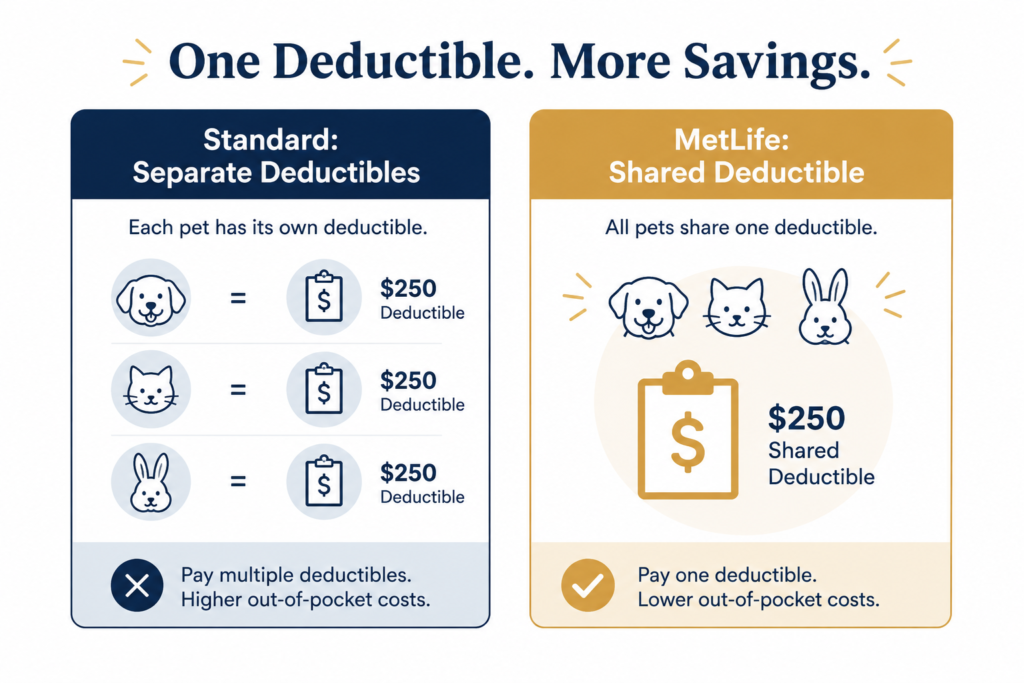
| MetLife | Shared family deductible (not a percentage discount) | Combines up to 3 pets under one $500 shared deductible instead of separate deductibles per pet |
| Lemonade | Multi-pet discount plus lowest overall base rates | Best overall value in 39 states plus D.C. according to 2026 rankings |
| Healthy Paws / Trupanion | No multi-pet discount offered | Worth factoring into your total cost comparison regardless |
(Discount availability and percentage vary by state. Always compare the full monthly cost across providers for your specific pets rather than comparing discount percentages alone, a company with a smaller discount but lower base rates can still come out cheaper overall.)
Why MetLife’s Approach Is Genuinely Different
Most multi-pet insurance discounts work as a percentage reduction on separate policies. MetLife instead uses a shared family deductible model for up to 3 pets on one policy. In a year where multiple pets have claims, a shared $500 deductible means your household pays $500 total before reimbursement kicks in, not $500 per pet, which could mean $1,500 total across 3 pets under a standard separate-policy structure. If you have multiple pets that are all reasonably likely to need vet care in the same year, this structural difference can matter more than a straightforward percentage discount would.
How Much Do Multi-Pet Insurance Discounts Actually Save?
Real savings depend heavily on your pets’ species, breed, and age, since base premiums vary so much to begin with. According to 2026 industry data, the average cost of insuring two dogs runs around $63 a month combined, and two cats around $32 a month combined, before any multi-pet discount is applied. With a 10% discount from a provider like Spot or Pumpkin, a three-pet household can realistically save $100 to $200 a year compared to insuring each pet at full individual pricing, and the savings scale up further for households with mid-to-high-cost breeds where individual premiums already run $30-$50 a month per pet.
More than one-third of pet owners currently have more than one pet insured, according to recent industry data, meaning multi-pet households make up a genuinely large share of the pet insurance market, not a small niche case most providers only casually accommodate.
Stacking Multi-Pet Insurance Discounts With Other Savings
This is worth knowing before you shop: multi-pet discounts can typically be combined with other savings, annual payment discounts, military or veteran discounts, and employee group discounts among them. A common, genuinely effective combination is pairing a multi-pet discount with an annual payment discount, since paying yearly instead of monthly often unlocks an additional percentage off on top of what you’re already saving per pet. It’s worth asking your specific insurer directly which discounts can stack, since this varies by company and isn’t always obvious from the online quote page alone.
Common Mistakes People Make With Multi-Pet Insurance Discounts
- Assuming every provider offers this discount. Healthy Paws and Trupanion currently offer none at all, worth factoring into your total cost comparison rather than assuming the discount exists everywhere.
- Comparing discount percentages instead of total household cost. A smaller discount from a provider with lower base rates can still beat a larger discount from a more expensive one, always compare the full monthly bill across your specific pets.
- Not asking whether discounts stack. Combining a multi-pet discount with an annual payment discount can meaningfully increase total savings, but this isn’t automatic, confirm it directly with your insurer.
- Assuming “one account” means shared costs. Most providers still bill each pet as a separate policy, MetLife’s shared deductible model is the exception, not the standard.
- Enrolling pets at different times without checking the discount timing. Some insurers, like ASPCA, apply the discount automatically when a new pet is added; others require you to request it directly, don’t assume it’s automatic everywhere.
- Ignoring waiting periods and pre-existing condition rules when adding a new pet. Multi-pet savings don’t offset the cost of missing a documented pre-existing condition on a newly added animal, review each pet’s specific terms individually.
Where This Leaves Me Now
My second dog ended up costing noticeably less than a standalone policy would have, once the discount was actually applied, and I switched my payment schedule to annual afterward once I realized that stacked on top of it. It’s a genuinely useful savings lever for multi-pet households, but only if you actually compare structures instead of assuming every provider handles it the same way.
If you’re adding a second (or third) pet to your household, it’s worth the fifteen minutes it takes to compare a few providers’ actual multi-pet structures before assuming your current insurer’s approach is the only one. If you’re also working through other coverage decisions, I’ve written about life insurance, home insurance, health insurance, and car insurance here on Insurance Pikr too.
For real-time quotes across multiple providers and current discount percentages, Insurify’s multi-pet insurance breakdown and Forbes Advisor’s best pet insurance for multiple pets ranking are both solid, current places to compare your specific pets before enrolling.
I write about this kind of practical, real-world insurance stuff regularly over on Insurance Pikr, so if this helped you save a little on your own multi-pet household, there’s more where it came from.