

How to Get a Business Owners Policy in 6 Easy Steps

You just signed the lease on a small shop. The landlord’s paperwork says you need general liability insurance and proof of property coverage before you get the keys. You search online and suddenly there are a dozen policy types with confusing names.
Then someone at a networking event says just get a BOP. That’s short for business owners policy. You nod like you know what that means. Honestly most new owners don’t.
A business owners policy is often the simplest and cheapest way for a small business to get the basic protection it needs. This guide explains what it covers and what it leaves out and what it really costs.
The quick answer
A business owners policy (BOP) bundles three coverages into one package. General liability and commercial property and business income insurance. Insureon’s data shows a median cost of about $83 a month or roughly $996 a year. Your price depends on your industry and location and how much property you need to cover.
What a BOP includes
Think of a business owners policy as a starter pack. It combines the coverages most small businesses need first.
General liability. This pays if your business injures someone or damages their property. A customer slips on a wet floor. Your employee knocks over a client’s expensive vase. Most BOPs offer limits around $1 million per incident and $2 million per year.
Commercial property. This protects your building if you own it. It also covers the stuff inside such as equipment and furniture and inventory. If you rent then it can cover improvements you made to the space.
Business income. This is the part people forget about. If a fire or storm forces you to close for a while this coverage helps replace lost income. It can also help pay ongoing bills like rent and payroll while you rebuild.
Buying these three separately usually costs more. That’s the whole appeal of a business owners policy.
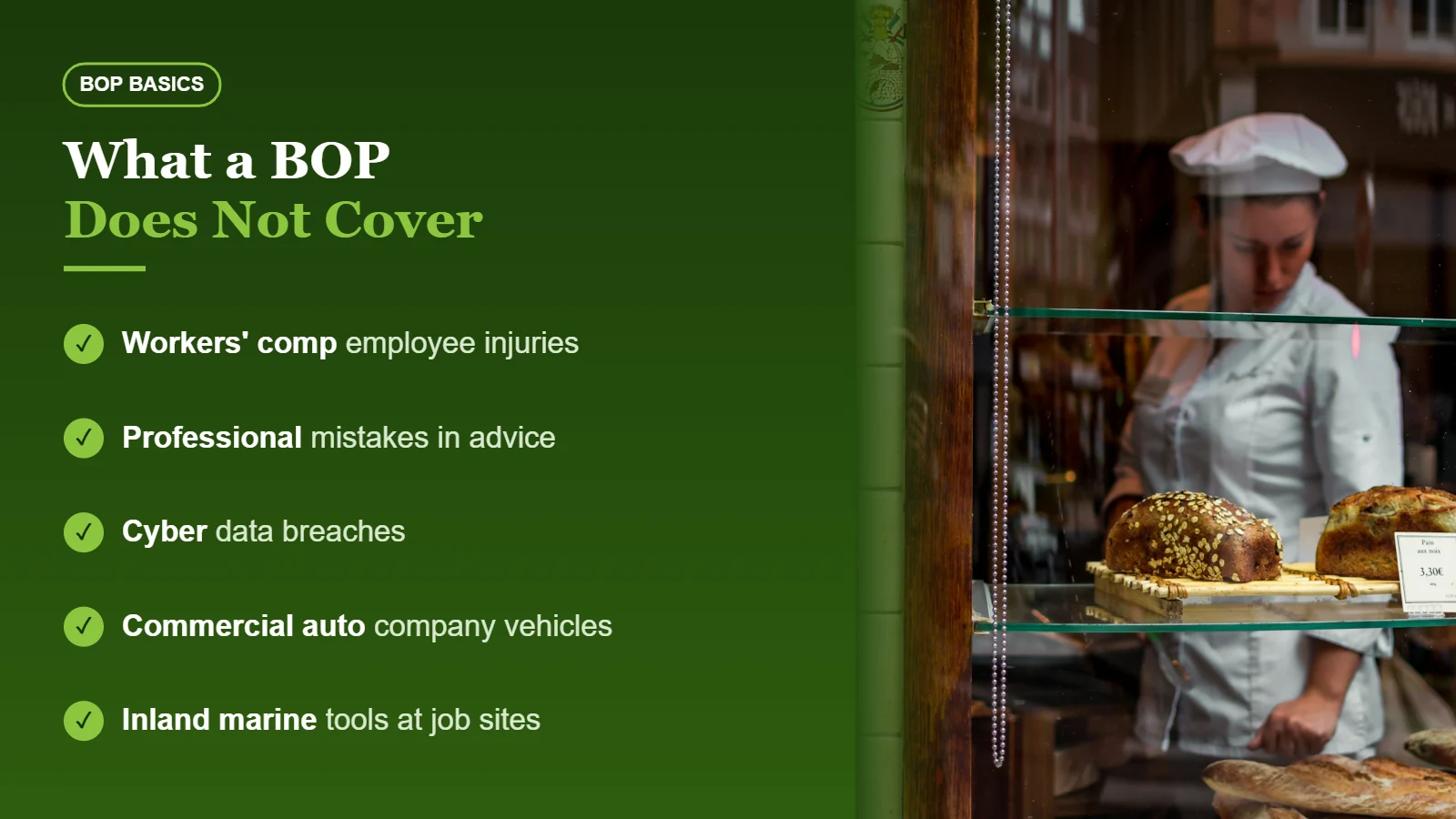
What a BOP does not cover
This is where many owners get surprised. A BOP is a strong base but it leaves real gaps.
| Risk | Covered by a BOP? | What you’d need instead |
|---|---|---|
| Customer injury at your shop | Yes | Included |
| Fire damage to your equipment | Yes | Included |
| Lost income after a covered fire | Yes | Included |
| Employee hurt on the job | No | Workers’ compensation |
| Mistake in your professional advice | No | Professional liability |
| Data breach or hack | No | Cyber insurance |
| Accident in a company vehicle | No | Commercial auto |
| Tools stolen from a job site | No | Inland marine |
Workers’ comp deserves a special note. Most states require it once you have employees. A BOP will never replace it. Our guide on workers’ compensation insurance for small business explains the rules.
If you give advice or provide a professional service then read our comparison of general liability vs professional liability insurance. They protect against very different things.
How much a BOP costs in 2026
Prices vary a lot by industry. Here’s what Insureon’s median numbers look like for a few common business types.
| Business type | Per month | Per year |
|---|---|---|
| Photographer | $47 | $570 |
| Consultant | $61 | $732 |
| Hair salon | $70 | $841 |
| Plumber | $213 | $2,559 |
| Full-service restaurant | $337 | $4,045 |
| Bar or tavern | $346 | $4,148 |
Across all businesses annual premiums range from about $400 to more than $6,000. Progressive Commercial reported a median of about $80 a month for its 2025 new customers.
The pattern makes sense. A photographer working from a laptop has little property and low foot traffic. A restaurant has hot kitchens and expensive equipment and lots of customers walking around.
What drives your price up or down
- Industry risk. More customers and more physical work usually means a higher price
- Location. Areas with more storms or crime or lawsuits cost more
- Property value. More equipment and inventory means more to insure
- Claims history. Past claims can raise your rate
- Coverage limits and deductible. Higher limits cost more and a higher deductible lowers the premium
- Building details. Age and construction type and sprinkler systems all matter
Are you eligible for a BOP
Not every business qualifies. BOPs are designed for small and medium businesses with fairly simple risks.
Under standard ISO rules many businesses can qualify with up to 35,000 square feet and up to $6 million in annual sales per location. ISO is the organization that writes many standard insurance forms. Each insurer can set its own limits though. Some small contractors and restaurants face tighter rules.
Businesses that often qualify include retail shops and offices and small service businesses and some restaurants. High-risk work like heavy manufacturing usually needs custom coverage instead.
If you work from home or run a side hustle you may not need a full BOP at all. Our guide to business insurance for freelancers and side hustles covers lighter options.

A hypothetical example
Picture a small bakery with two employees in a rented storefront. The owner buys a BOP.
One winter a pipe bursts and floods the kitchen. The ovens are damaged and the bakery has to close for three weeks.
The property part of the BOP helps pay to repair or replace the ovens. The business income part helps cover lost sales and keeps paying rent and the two employees while the kitchen gets fixed. That’s often what keeps a small business alive after a disaster.
Now imagine one employee burns her hand on an oven. The BOP doesn’t cover that. Workers’ compensation does. This is exactly why owners need to know where the BOP stops.
6 easy steps to buy the right business owners policy
Step 1: List what you need to protect. Equipment and inventory and improvements to your space.
Step 2: Check your lease or contracts. Landlords and clients often require specific coverage limits.
Step 3: Get at least three quotes. Compare the same limits and deductibles so you’re comparing fairly.
Step 4: Ask what’s excluded. Flooding and earthquakes are usually not covered by a standard BOP.
Step 5: Ask about add-ons. Many insurers let you add things like data breach or equipment breakdown coverage to a BOP.
Step 6: Review it every year. As your business grows your coverage needs grow too.
Signs you’ve outgrown a BOP
A BOP fits a lot of small businesses well. But growth can push you past what it was built for. Watch for these signs.
- You need higher limits. A big client contract may require $5 million in liability coverage. Many BOPs can’t stretch that far without an umbrella policy
- Your property is worth a lot more. Expensive machines or large inventory may need a separate commercial property policy
- You opened a second location. Some insurers treat each location separately and the rules can change
- Your work got riskier. Adding delivery or construction or manufacturing can move you out of BOP eligibility
- Your sales jumped. Crossing the revenue limit set by your insurer can mean you need a custom package
None of this is bad news. It usually means the business is growing. Just call your agent before renewal so your coverage grows with it.
Common mistakes
- Underinsuring your property. Count everything including small equipment and stock
- Thinking a BOP covers employees. It doesn’t. Workers’ comp is separate
- Skipping business income coverage. Some owners remove it to save money. It’s often the most important part
- Forgetting about flood. Standard BOPs usually exclude it
- Buying the cheapest quote without reading it. Low price can mean low limits
Frequently asked questions
Is a BOP the same as general liability insurance
No. General liability is one part of a BOP. A BOP also adds property and business income coverage.
Do home-based businesses need a BOP
Sometimes. Homeowners insurance often covers very little business property or liability. A home business endorsement or a small BOP may help depending on your work.
Can I add cyber coverage to a BOP
Many insurers offer a limited data breach add-on. For bigger risks a separate policy is often better. Our guide to cyber insurance for small business explains the difference.
Is a BOP required by law
No law requires a business owners policy. But landlords and lenders and clients often require the coverages it includes.
Final thoughts
A business owners policy won’t cover everything. But for many small businesses it covers the most common disasters at a fair price. Know what’s inside the bundle and fill the gaps with the right extra policies.
And re-check your coverage when you add employees or move or buy expensive equipment. The policy that fit your first year may not fit your third. For a bigger picture read our guide to the best business insurance in the USA.
Disclaimer: This article is general information and not advice for your business. Coverage and prices vary by state and insurer and industry. Check with a licensed commercial insurance agent before you buy.