

Full Coverage vs Liability: 3 Smart Ways to Pay Less

Your car insurance renewal shows up and the price went up again. You do the math on the car itself. It’s eight years old with more than 120,000 miles. And a little voice asks the obvious question. Why am I paying so much to protect a car that isn’t worth much anymore?
That voice is worth listening to. The choice between full coverage and liability only is one of the biggest money decisions in car insurance. Get it right and you can save hundreds a year. Get it wrong and one bad crash can leave you without a car and without the money to replace it.
The quick answer
Liability only pays for damage and injuries you cause to other people. Full coverage adds collision and comprehensive so your own car gets fixed or replaced too. Full coverage averages about $2,243 a year compared with $1,184 for liability only according to Insurify. Dropping full coverage often makes sense when your yearly cost for it is more than about 10% of your car’s value.
What full coverage actually means
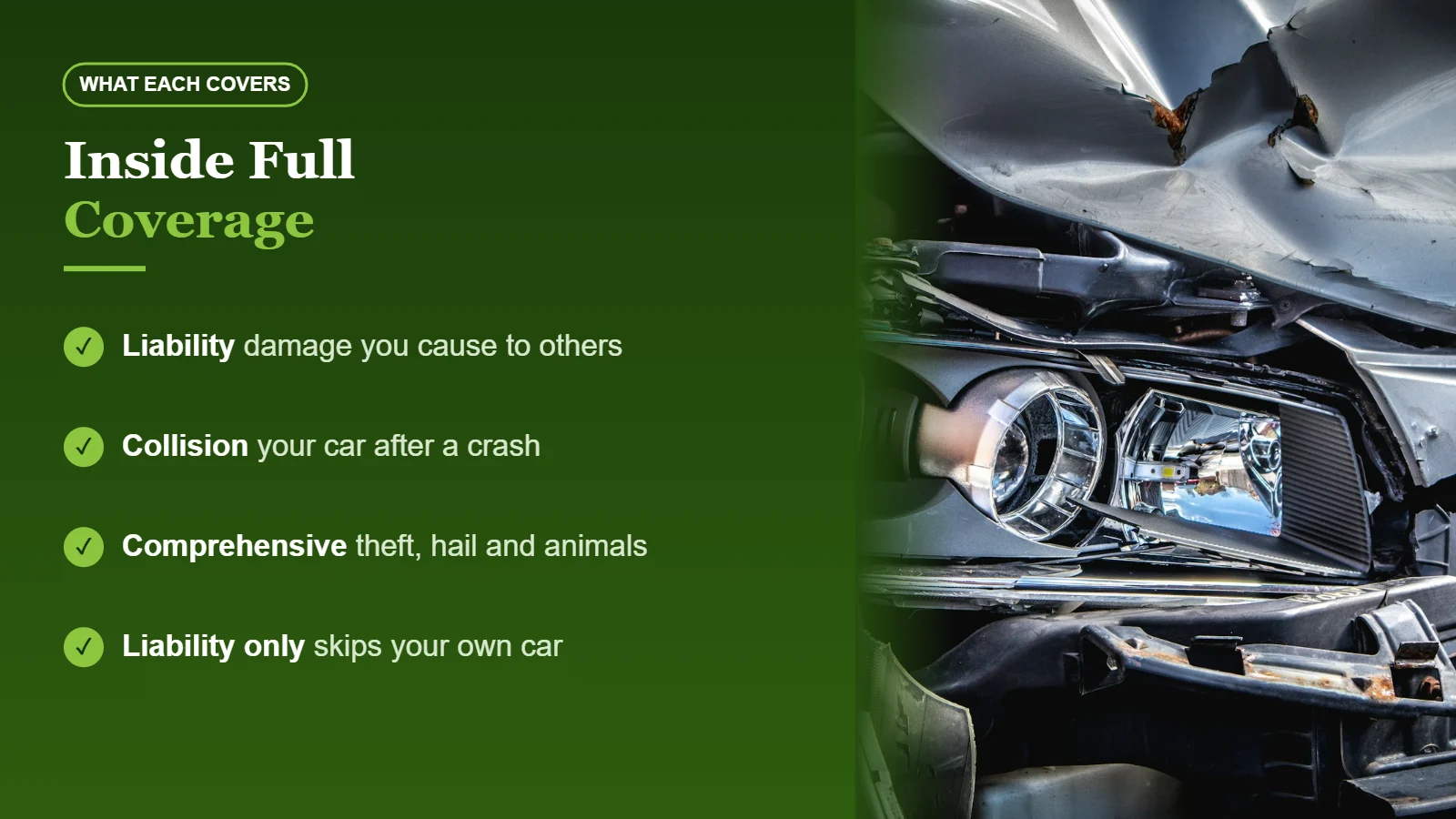
Here’s something most people don’t know. Full coverage isn’t an official type of policy. It’s a nickname for a bundle of three coverages.
- Liability pays for other people’s injuries and property damage when you’re at fault
- Collision pays to repair your car after a crash with another car or an object like a pole or a fence
- Comprehensive pays for damage that isn’t a crash such as theft or hail or a falling tree or hitting a deer
Liability only means you keep the first item and drop the other two. Your car is on its own if something happens to it.
Nearly every state requires liability insurance. No state requires collision or comprehensive by law. Lenders do though.
The real price difference
Insurify’s November 2026 data puts the average cost at:
| Coverage | Per year | Per month |
|---|---|---|
| Full coverage | $2,243 | about $187 |
| Liability only | $1,184 | about $99 |
That’s a gap of more than $1,000 a year on average. Your own numbers will look different because rates depend on your state and age and driving record and car. But the gap is usually big enough to deserve a real look.
If your rates keep climbing for no clear reason our article on why car insurance rates are rising explains what’s going on.
When you must keep full coverage
Some situations don’t leave you a choice.
You have a car loan or lease. Lenders almost always require full coverage for the life of the loan. Many also set a maximum deductible such as $500 or $1,000. If you drop coverage your lender can buy force-placed insurance and add it to your loan balance. That kind of policy can cost two to five times the normal rate and it protects only the lender. Not you.
You couldn’t afford to replace the car. If losing this car would mean losing your way to work then full coverage is doing important work.
The car is newer or worth a lot. A total loss on a $25,000 car can wipe out years of premium savings in one afternoon.
When dropping full coverage makes sense
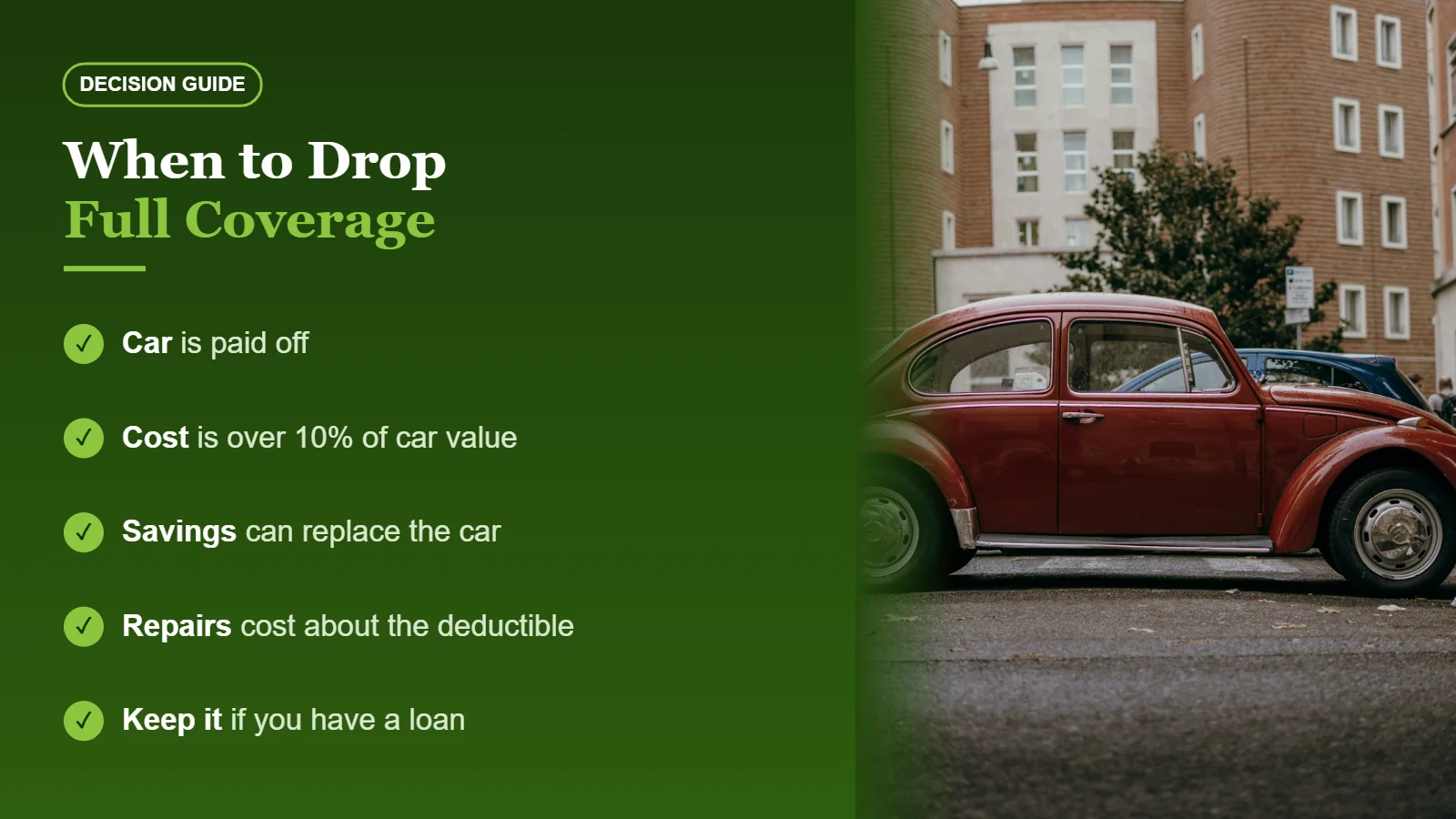
This is where the 10% rule helps. Add up what collision and comprehensive cost you each year. Then compare that number with your car’s value.
If the yearly cost of those two coverages is more than about 10% of what the car is worth then it may be time to drop them.
Use the private party value from Kelley Blue Book or Edmunds. Not the lower trade-in number.
Other signs it might be time:
- The car is paid off and you have the title
- You have enough savings to replace or fix the car yourself
- Your deductible is high enough that most repairs would cost about the same as the deductible
- The car is old and repairs would cost more than it’s worth anyway
A hypothetical example
Picture someone with a paid-off 2016 sedan. Private party value is about $7,000. Collision and comprehensive together cost $900 a year with a $1,000 deductible.
That $900 is nearly 13% of the car’s value. And here’s the catch nobody mentions. If the car were totaled the insurer would pay about $7,000 minus the $1,000 deductible. So the most this coverage could ever pay is about $6,000.
Paying $900 a year to protect $6,000 isn’t terrible. But after about six years without a claim the premiums alone would add up to the whole payout. If this person has an emergency fund then dropping to liability and saving the difference could make sense.
Now picture the same car owned by someone with no savings who needs it to get to work. The math says drop it. Real life says maybe not. Both answers can be right.
Don’t go too low on liability
If you switch to liability only please don’t drop to your state’s minimum limits. Minimums are often very low. A serious crash with injuries can easily cost more than a minimum policy pays. Then you could be personally responsible for the rest.
Liability is the part that protects your savings and your future paychecks. It’s the last place to cut. Many people choose limits like 100/300/100. That means up to $100,000 per injured person and $300,000 per crash for injuries and $100,000 for property damage.
3 smart ways to pay less without dropping everything
You don’t have to choose all or nothing.
Way 1: Keep comprehensive and drop collision. Comprehensive is often cheap. It covers theft and hail and animals and fallen trees. If you live where hail is common or car theft is high this can be a smart compromise.
Way 2: Raise your deductible. Moving from $500 to $1,000 can lower your premium a lot. Just make sure you could pay that amount tomorrow.
Way 3: Look at usage-based insurance. If you don’t drive much a pay-per-mile plan may help. Our guide on usage-based car insurance explains how it works.
How to decide in 6 easy steps
Step 1: Look up your car’s private party value on Kelley Blue Book or Edmunds.
Step 2: Ask your insurer for the exact yearly cost of collision and comprehensive. It’s usually listed separately on your policy.
Step 3: Divide that cost by the car’s value. Over 10% is a signal to think about dropping it.
Step 4: Check your loan or lease paperwork. If there’s a lender then full coverage likely stays.
Step 5: Check your savings. Could you replace the car if it were totaled tomorrow?
Step 6: Get a liability only quote with strong limits. Then compare the real savings.
Common mistakes
- Dropping full coverage on a financed car. Force-placed insurance is expensive and protects only the lender
- Using trade-in value. It makes your car look less valuable than it is
- Cutting liability to the state minimum. That’s where the biggest financial risk lives
- Forgetting gap insurance on a new loan. In the first years of a long loan you may owe more than the car is worth. Gap insurance covers that difference
- Never checking again. Your car loses value every year so redo the math at each renewal
Frequently asked questions
Is full coverage required by law
No. States require liability insurance. Collision and comprehensive are optional by law but lenders usually require them.
Does liability insurance cover my car if someone hits me
If the other driver is at fault their liability insurance should pay for your car. Uninsured motorist coverage can help if they have no insurance or not enough.
Can I add full coverage back later
Usually yes. Many insurers can restore it quickly. Some may want to inspect the car first.
What does full coverage not cover
It doesn’t cover normal wear and tear or mechanical breakdowns. It also doesn’t cover personal items stolen from the car. Those usually fall under renters or homeowners insurance.
Final thoughts
There’s no single right answer here. A newer car with a loan needs full coverage. An old paid-off car with savings behind it often doesn’t. The 10% rule gets you most of the way. Your own budget and peace of mind do the rest.
Check the numbers once a year. Cars lose value quietly and the right answer can change before you notice. For more ways to save see our guide to the best car insurance policy in the USA.
Disclaimer: This article is general information and not advice for your exact case. Rates and coverage rules vary by state and insurer. Talk with a licensed agent before you change your coverage.